Staff Knowledge Check
Test your understanding with real-life scenario questions. Great for team discussion or self-check.
Q1. A client with arthritis in both hands finds it painful to grip standard utensils. What would be a suitable solution?
- A) Recommend weighted cutlery
- B) Suggest wide-handled, ergonomic cutlery
- C) Offer lightweight plastic utensils
- D) Suggest they eat only finger food
🎉 You are correct! Wide, ergonomic handles reduce the strain on joints and improve control.
❌ Incorrect. Weighted cutlery is more suited to tremor control, not joint pain.
❌ Incorrect. Lightweight options can help, but grip design is more important for arthritis.
❌ Incorrect. Clients should not be limited unnecessarily when solutions are available.
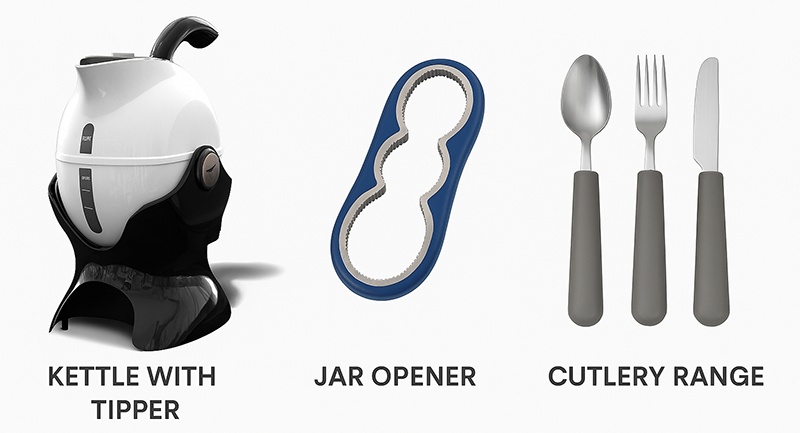
Q2. Why might a kettle tipper be recommended for someone recovering from a stroke?
- A) Because it looks nicer on the bench
- B) It helps prevent over-boiling
- C) It allows safe, one-handed pouring with reduced lifting strain
- D) Because they can't use a microwave
🎉 You are correct! A kettle tipper allows pouring without having to lift or steady the kettle, reducing spill and burn risk.
❌ Incorrect. Aesthetic preference is not a clinical justification.
❌ Incorrect. Kettle tippers do not control boiling—they assist with pouring.
❌ Incorrect. Microwave use is unrelated to safe kettle handling.
Q3. A client with reduced hand strength wants to open jars and drink bottles independently. What aid is most suitable?
- A) Adaptive chopping board
- B) Non-slip mat
- C) Multi-purpose jar and bottle opener
- D) Modified cutlery
🎉 You are correct! These tools improve grip and leverage to assist with opening tight lids safely.
❌ Incorrect. Chopping boards assist with food prep, not opening containers.
❌ Incorrect. Non-slip mats help stabilise items but don’t help twist lids.
❌ Incorrect. Modified cutlery aids in eating, not opening containers.
Q4. A carer says the client struggles with meal prep because they can’t stabilise food while chopping. Which aid should you suggest?
- A) A rocker knife
- B) A one-handed chopping board with stabilisers
- C) A food processor
- D) A suction bowl
🎉 You are correct! These boards hold food in place for safe one-handed use and improved independence.
❌ Incorrect. A rocker knife may reduce cutting effort but won’t hold food stable.
❌ Incorrect. While helpful, a food processor may be unsafe for clients with cognitive or physical limitations.
❌ Incorrect. Suction bowls are for eating, not food prep.
Q5. What is a key safety benefit of using a non-slip mat under bowls or plates during meal prep or eating?
- A) It makes meals look more appealing
- B) It adds colour contrast for low vision
- C) It keeps items stable to reduce spill and injury risk
- D) It protects the bench from heat
🎉 You are correct! Non-slip mats improve control and prevent movement of items during use.
❌ Incorrect. Appearance is not the primary purpose.
❌ Incorrect. While helpful for vision, the core purpose is stability and safety.
❌ Incorrect. Heat protection is not the main concern with these mats.
Q6. A client has tremors and struggles to keep food on their plate. What would you suggest?
- A) A standard porcelain plate with lip
- B) A plate guard or high-sided plate
- C) A smaller plate so food portions are reduced
- D) A bowl instead of a plate
🎉 You are correct! A plate guard or high-sided plate helps prevent spills by containing food during scooping.
❌ Incorrect. A lip may help slightly, but proper guards provide more containment.
❌ Incorrect. Smaller portions won’t address the cause of spillage.
❌ Incorrect. A bowl may help but doesn't offer the same mealtime flexibility as a guarded plate.
Q7. Why might someone with only one functional hand need adaptive cutlery?
- A) To improve posture while eating
- B) Because standard cutlery may require two hands for some tasks
- C) So the food stays warmer longer
- D) To assist the carer during feeding
🎉 You are correct! Angled, bendable, or combined-use cutlery can assist one-handed users to eat independently.
❌ Incorrect. While posture is important, that’s not the primary reason here.
❌ Incorrect. Temperature retention isn’t relevant to function.
❌ Incorrect. The goal is independent eating, not carer assistance.
Q8. A customer wants to help their elderly mum remain independent with hot drink preparation. Which solution is most appropriate?
- A) Offer to make drinks for her instead
- B) Provide a non-slip mug with two handles
- C) Recommend a travel mug with a straw
- D) Suggest a microwave instead of a kettle
🎉 You are correct! A stable, easy-to-grip mug helps maintain independence and reduces spill risk.
❌ Incorrect. Independence is the priority here—not replacing it with help.
❌ Incorrect. Travel mugs may be difficult to clean or fill for older users.
❌ Incorrect. A microwave avoids boiling but doesn’t assist with safe handling or drinking.
Q9. A client has poor coordination and frequently knocks over their drinks. What would you suggest?
- A) A plastic mug instead of ceramic
- B) A wide-based, weighted cup with lid
- C) A smaller cup to reduce volume
- D) A brightly coloured mug for visibility
🎉 You are correct! A weighted base and spill-proof lid can help reduce spills and promote confidence.
❌ Incorrect. Plastic reduces break risk but not tipping risk.
❌ Incorrect. Less liquid won’t stop spills if coordination is poor.
❌ Incorrect. Colour contrast may assist visually but not with stability.
Q10. Why are many kitchen aids designed with bright, contrasting colours?
- A) To match modern kitchens
- B) For marketing appeal
- C) To improve visibility for people with low vision or cognitive impairment
- D) To indicate they are funded items
🎉 You are correct! High-contrast colours assist with visibility and recognition for clients with vision or memory challenges.
❌ Incorrect. Aesthetics are secondary to accessibility and safety.
❌ Incorrect. While marketing may use colour, the function is clinical.
❌ Incorrect. Colour coding is not related to funding eligibility.
Q11. A client has limited wrist movement and struggles to use a standard knife. What adaptive tool would help most?
- A) A curved rocker knife
- B) A bread knife
- C) A serrated steak knife
- D) A plastic knife for safety
🎉 You are correct! A rocker knife allows cutting with minimal wrist movement by using a rocking motion.
❌ Incorrect. Bread knives require standard sawing motion—challenging for limited mobility.
❌ Incorrect. A steak knife still requires standard grip and pressure.
❌ Incorrect. Plastic knives are safe but ineffective for most food prep tasks.
Q12. Why is an angled or bendable spoon helpful for clients with limited upper limb mobility?
- A) It holds more food than a standard spoon
- B) It improves food temperature control
- C) It reduces the range of motion required to bring food to the mouth
- D) It keeps the wrist elevated
🎉 You are correct! Angled spoons reduce the need for wrist or shoulder movement during feeding.
❌ Incorrect. Food capacity is not the key benefit here.
❌ Incorrect. Temperature control is unrelated to spoon shape.
❌ Incorrect. The goal is reducing joint strain—not wrist elevation.
Q13. A customer asks if kitchen aids are suitable for people recovering from surgery. What’s an appropriate response?
- A) Yes, they’re only for post-surgical clients
- B) No, they’re mostly used in aged care
- C) Yes, many aids help people regain independence while recovering
- D) No, they're only funded for long-term disabilities
🎉 You are correct! Kitchen aids can support temporary or permanent mobility and coordination challenges.
❌ Incorrect. Kitchen aids are used across a wide range of needs—not just post-surgical.
❌ Incorrect. While common in aged care, they’re helpful in rehab and general disability care too.
❌ Incorrect. Funding depends on need, not just duration of disability.
Q14. Why is it important to demonstrate or explain how to use a jar opener to a new user?
- A) The tools can be complex and confusing at first
- B) Jar openers have expiry dates
- C) So the client doesn’t need to read instructions
- D) It’s required by warranty
🎉 You are correct! Even simple tools may need hands-on explanation to boost client confidence and correct use.
❌ Incorrect. These products don’t have expiry dates.
❌ Incorrect. Reading support materials is helpful—but showing is better for many users.
❌ Incorrect. No such requirement exists.
Q15. A client with memory issues often forgets where they placed important kitchen items. What can help?
- A) Adaptive kitchen labels and consistent storage layout
- B) Replacing items with brightly coloured ones
- C) Installing a TV in the kitchen
- D) Switching to plastic-only tools
🎉 You are correct! Labelling and structured routines support memory and independence in daily tasks.
❌ Incorrect. Colour alone doesn’t solve memory issues.
❌ Incorrect. A TV would likely be distracting and unhelpful.
❌ Incorrect. Material choice isn’t directly linked to memory support.
Q16. A client has recently transitioned to one-handed use following an injury. Which feature is most important in a chopping board for them?
- A) Built-in measuring lines
- B) Suction base and stabilising spikes
- C) Large cutting surface
- D) Removable draining tray
🎉 You are correct! These features help hold food steady and prevent the board from moving during prep.
❌ Incorrect. Measuring lines are useful but don’t help with one-handed use.
❌ Incorrect. Size alone doesn’t improve control or safety.
❌ Incorrect. A draining tray is helpful for rinsing but not essential for stability.
Q17. What is the benefit of using utensils with built-up handles for clients with neurological conditions?
- A) They help improve posture
- B) They improve grip and reduce fine motor strain
- C) They help keep food warmer
- D) They are easier to clean
🎉 You are correct! Larger handles require less grip strength and help those with tremors, spasticity or reduced coordination.
❌ Incorrect. Handle size doesn’t affect posture significantly.
❌ Incorrect. Material or insulation affects temperature, not handle design.
❌ Incorrect. Cleaning ease depends on surface and shape, not size alone.
Q18. A carer is choosing between a kettle tipper and a one-touch hot water dispenser. What’s a key safety consideration?
- A) Whether the client likes the sound the appliance makes
- B) Whether the dispenser automatically locks after each use
- C) Whether the client can manage controls and avoid hand placement near hot water flow
- D) Whether it matches their existing toaster
🎉 You are correct! Hands-free or one-touch operation is helpful only if the client can safely position hands and use the controls.
❌ Incorrect. Sound is a comfort feature—not a key safety factor.
❌ Incorrect. Locking can help, but user safety during pouring is the priority.
❌ Incorrect. Aesthetic matching is not relevant to function or safety.
Q19. What is a key benefit of using a suction bowl or plate during mealtimes?
- A) It keeps food warmer for longer
- B) It makes cleaning easier
- C) It prevents slipping and helps users scoop food without chasing the dish
- D) It adds more variety to meals
🎉 You are correct! Suction keeps the bowl still, allowing better control and reducing frustration or spillage.
❌ Incorrect. Suction doesn’t affect temperature.
❌ Incorrect. Cleaning is the same regardless of base style.
❌ Incorrect. The tool doesn’t influence dietary variety.
Q20. Why should you avoid recommending very small or fiddly kitchen aids to clients with cognitive or visual impairments?
- A) They cost more
- B) They're harder to keep track of, identify, and use safely
- C) They aren't sold in stores
- D) They may not look appealing
🎉 You are correct! Clients with vision or memory issues need large, recognisable, easy-to-use aids for safety and confidence.
❌ Incorrect. Price is not the primary concern in this case.
❌ Incorrect. Some small aids are available—but not always suitable.
❌ Incorrect. Visual appeal is less important than function and safety.
Q21. A client says they often drop cutlery during meals. What would be the best first step to reduce this issue?
- A) Recommend eating finger food instead
- B) Use cutlery with built-up, non-slip handles
- C) Advise switching to plastic utensils
- D) Suggest wearing gloves to improve grip
🎉 You are correct! Adaptive cutlery with ergonomic, non-slip handles improves grip and reduces the chance of dropping.
❌ Incorrect. Finger food reduces independence and dignity in many settings.
❌ Incorrect. Plastic is lighter, but not easier to grip or control.
❌ Incorrect. Gloves may reduce tactile feedback and worsen grip issues.
Q22. What’s the main advantage of using a lid on an adaptive cup or mug?
- A) It keeps the drink warm longer
- B) It prevents spills and controls flow, improving safety
- C) It makes the cup look more modern
- D) It reduces cleaning effort
🎉 You are correct! Lids improve control during drinking, helping users avoid spills or choking.
❌ Incorrect. That’s a minor side benefit, not the primary purpose.
❌ Incorrect. Aesthetic appeal is not the key advantage.
❌ Incorrect. In fact, lids may require more cleaning effort.
Q23. A client wants to regain independence but is fearful of hot liquids. What’s a good product to build confidence safely?
- A) A wide-based mug with a lid and handles
- B) A straw and a glass
- C) A paper cup with a sleeve
- D) A standard kettle and porcelain cup
🎉 You are correct! Secure grip and spill control are critical for building confidence with hot drinks.
❌ Incorrect. A straw may not prevent spills or burns from unstable handling.
❌ Incorrect. Disposable cups lack stability and safety features.
❌ Incorrect. This combination may increase spill and burn risk.
Q24. Why are jar openers and non-slip mats often used together?
- A) They come in a matching set
- B) They improve hygiene during food prep
- C) They provide grip for both hands—one to stabilise, one to open
- D) They reduce noise in the kitchen
🎉 You are correct! The mat helps hold the jar still while the opener provides grip and torque control.
❌ Incorrect. This is not a style choice—it’s a function-based combination.
❌ Incorrect. Hygiene may improve indirectly but that’s not the purpose.
❌ Incorrect. Noise reduction is not a relevant factor here.
Q25. What role do high-contrast colours play in the design of many kitchen aids?
- A) They are easier to market
- B) They are preferred by interior designers
- C) They help clients with visual or cognitive impairments identify items more easily
- D) They indicate product expiry
🎉 You are correct! High-contrast colours support safety, especially for clients with dementia or low vision.
❌ Incorrect. While colours may help marketing, the function is clinical.
❌ Incorrect. Design trends don’t drive colour use in assistive tools.
❌ Incorrect. Colours are not used to mark expiry.
Q26. A customer is concerned their mother forgets to eat meals. Which kitchen aid feature could help promote routine and recognition?
- A) Colourful, recognisable utensils placed in visible locations
- B) A hidden drawer for snacks
- C) Scented placemats
- D) A timer kettle that shuts off after 30 seconds
🎉 You are correct! Bright, consistent utensils can act as memory cues and encourage regular mealtimes.
❌ Incorrect. Hidden snacks are not a helpful reminder.
❌ Incorrect. Scented placemats are not common or reliable reminders.
❌ Incorrect. Kettles with timers help with safety, not with memory or eating cues.
Q27. A client with arthritis has trouble gripping lids. What might be the best combination to help them open jars safely?
- A) Latex gloves and a cloth
- B) Non-slip mat and a jar opener with leverage grip
- C) Asking a neighbour to help
- D) Switching to pre-cut food
🎉 Correct! A non-slip base and a grippy opener can make it easier to open jars without strain or risk.
❌ Incorrect. This may help slightly, but it lacks the stability and grip provided by proper tools.
❌ Incorrect. The aim is to promote independence, not reliance on others.
❌ Incorrect. This doesn’t resolve the issue of accessing sealed containers.
Q28. What is a practical reason to choose cutlery with angled heads for some clients?
- A) They allow for a fancier eating experience
- B) They reduce the need for shoulder or elbow rotation during eating
- C) They cut food more easily
- D) They match with adaptive plates
🎉 Correct! Angled cutlery assists people with limited range of motion by requiring less awkward arm positioning.
❌ Incorrect. Angled design is for function, not style.
❌ Incorrect. The angle affects reach, not cutting ability.
❌ Incorrect. Matching isn’t important for effective function.
Q29. A carer wants to simplify food preparation for a client with mild cognitive impairment. Which aid is most suitable?
- A) Complex food processor with multiple blades
- B) Adaptive chopping board with fixed spikes and corner guides
- C) Standard plastic cutting mat
- D) Blunt knife and paper towel for cutting
🎉 Correct! These boards reduce decision-making and improve safety and independence in food prep.
❌ Incorrect. Complex devices can be overwhelming or unsafe.
❌ Incorrect. These slip easily and offer no support.
❌ Incorrect. This is unsafe and ineffective.
Q30. What is the purpose of a kettle tipper?
- A) To reheat water more quickly
- B) To improve water flavour
- C) To pour boiling water safely without lifting a heavy kettle
- D) To measure water more accurately
🎉 Correct! Kettle tippers reduce the strain and risk of spills by allowing controlled pouring without lifting.
❌ Incorrect. Kettle tippers are not heating tools.
❌ Incorrect. The water taste is unaffected by the tipper.
❌ Incorrect. Measurement is a function of the kettle, not the tipper.
Q31. Why are some assistive cups designed with a wider base?
- A) To hold more liquid
- B) To improve dishwasher compatibility
- C) To reduce the chance of tipping or spills
- D) To match bowl sets
🎉 Correct! A wide base provides greater stability, reducing the chance of spills—especially for clients with tremors or coordination issues.
❌ Incorrect. Capacity isn’t the primary design reason for a wide base.
❌ Incorrect. Dishwasher use isn’t a factor in base shape.
❌ Incorrect. Design coordination is not clinically relevant.
Q32. A client asks if they should choose lightweight or heavy utensils. What factor should guide your answer?
- A) Their table size
- B) Their colour preferences
- C) Their grip strength and motor control
- D) How often they eat outdoors
🎉 Correct! Lighter cutlery may be easier to lift, but some clients with tremors benefit from heavier options that add stability.
❌ Incorrect. Table size is unrelated to this decision.
❌ Incorrect. Colour is a preference, not a suitability factor.
❌ Incorrect. Outdoor use doesn’t dictate utensil weight suitability.
Q33. What is the benefit of a spout cup for someone with swallowing difficulties?
- A) It delivers liquid in a slow, controlled stream
- B) It is easier to wash
- C) It looks more like a child’s sippy cup
- D) It holds more fluid
🎉 Correct! A spout cup helps control flow rate and reduce aspiration risk—important for dysphagia management.
❌ Incorrect. Cleaning is not the key advantage.
❌ Incorrect. Style comparisons aren’t relevant to its function.
❌ Incorrect. Volume isn’t the primary concern—flow control is.
Q34. Why might a client with vision impairment benefit from contrast-coloured plates?
- A) It makes the plate look more appealing
- B) It helps them identify where the food is on the plate
- C) It changes the taste of food
- D) It absorbs more heat from hot food
🎉 Correct! High-contrast colours help users distinguish between plate and food, reducing confusion or spills.
❌ Incorrect. Style isn’t the main concern.
❌ Incorrect. Colour doesn’t affect taste.
❌ Incorrect. Colour doesn’t significantly impact heat absorption in this context.
Q35. What is the purpose of a food preparation aid with a raised edge or corner guard?
- A) To create neater food presentation
- B) To reduce mess from slicing
- C) To stabilise bread or food for spreading or cutting
- D) To store extra food
🎉 Correct! A corner guard allows one-handed users to stabilise food without it slipping while spreading or cutting.
❌ Incorrect. It’s a functional—not decorative—feature.
❌ Incorrect. The goal is stability, not mess control.
❌ Incorrect. It’s not a storage feature.
Q36. A client has recently had a stroke and has poor coordination on their left side. What kitchen feature is most helpful for preparing food independently?
- A) A heavier knife with a sharp blade
- B) A one-handed food prep board with suction and spikes
- C) A lightweight cutting board with a handle
- D) Colour-coded chopping boards
🎉 Correct! A one-handed board stabilises food and assists cutting using only one side of the body.
❌ Incorrect. A sharp knife can help, but not without a stable work surface.
❌ Incorrect. Lightweight boards can slide and offer no one-handed support.
❌ Incorrect. Colour-coding is useful for hygiene, not coordination.
Q37. Which adaptive utensil is most appropriate for someone with limited wrist rotation?
- A) Standard metal spoon
- B) Weighted fork
- C) Angled spoon
- D) Plastic cutlery set
🎉 Correct! Angled utensils reduce the need to twist the wrist to bring food to the mouth.
❌ Incorrect. Standard spoons require more wrist movement.
❌ Incorrect. Weight helps with tremors, not joint rotation.
❌ Incorrect. Plastic sets don’t address wrist limitations.
Q38. Why might an Occupational Therapist recommend a scoop plate?
- A) It makes food look more appealing
- B) It helps control portion size
- C) It provides a high edge for one-handed scooping
- D) It prevents the plate from heating up
🎉 Correct! Scoop plates assist users with limited hand function by providing a surface to push food against while scooping.
❌ Incorrect. This is a functional—not decorative—tool.
❌ Incorrect. The edge design isn’t for portion control.
❌ Incorrect. It does not affect heat retention.
Q39. What is the benefit of a two-handled mug for clients with tremors or weakness?
- A) It can carry more liquid
- B) It allows better stability and control while drinking
- C) It looks more symmetrical
- D) It prevents the cup from being put in the dishwasher
🎉 Correct! Two handles let the user stabilise the mug with both hands, reducing the chance of spills.
❌ Incorrect. Capacity is unrelated to handle design.
❌ Incorrect. Symmetry is not a clinical factor.
❌ Incorrect. Handle design doesn’t restrict cleaning method.
Q40. A carer asks for help choosing an opener for clients with arthritis. What is an important feature to recommend?
- A) A small handle to minimise movement
- B) A curved design with soft grip for leverage
- C) A metal edge for more grip
- D) A compact design that fits in a pocket
🎉 Correct! Ergonomic, soft-grip handles with leverage are ideal for those with joint pain or limited hand strength.
❌ Incorrect. Small handles increase strain and reduce control.
❌ Incorrect. Metal edges may not offer enough comfort or grip.
❌ Incorrect. Portability is not the priority—ease of use is.
Q41. What feature of an electric jar opener benefits clients with very limited hand strength?
- A) It uses voice activation
- B) It opens jars silently
- C) It requires no grip or manual twisting
- D) It warms the jar before opening
🎉 Correct! Electric jar openers do the work of gripping and twisting, which is especially helpful for those with arthritis or limited strength.
❌ Incorrect. Most models use button control, not voice.
❌ Incorrect. Quiet operation is not the primary benefit.
❌ Incorrect. These devices don’t heat jars.
Q42. What makes a rocker knife easier to use for people with only one functional hand?
- A) It cuts using a rocking motion instead of sawing
- B) It is smaller than regular knives
- C) It can be used upside down
- D) It is made of plastic
🎉 Correct! A rocker knife allows safe one-handed cutting with minimal movement and effort.
❌ Incorrect. Size isn’t the defining feature.
❌ Incorrect. Rocker knives are not designed to be flipped.
❌ Incorrect. Material choice varies—it's the motion that matters.
Q43. Why are suction bases important on some adaptive kitchen tools?
- A) They allow tools to be wall-mounted
- B) They stop movement on the bench during use
- C) They help preserve battery power
- D) They make tools easier to store
🎉 Correct! Suction keeps tools steady during use, especially helpful for users with only one hand or limited dexterity.
❌ Incorrect. Suction bases are designed for bench stability, not hanging.
❌ Incorrect. Suction has no relation to energy usage.
❌ Incorrect. Storage is not the key benefit of suction.
Q44. A customer is buying for someone in early-stage dementia. What kitchen aid feature can reduce confusion?
- A) Clear labels and colour-coded features
- B) Very small utensils
- C) Randomised designs and patterns
- D) Transparent handles and dishes
🎉 Correct! Clear visual cues help users recognise and remember how to use each item, reducing anxiety and mistakes.
❌ Incorrect. Small items can be harder to handle and easier to lose.
❌ Incorrect. Inconsistent design can increase confusion.
❌ Incorrect. Transparency may make objects harder to see clearly.
Q45. A client with low vision is struggling to pour drinks. What feature could help them most?
- A) A tall, clear jug with no markings
- B) A jug with audible pour level indicators or tactile markers
- C) A cold beverage dispenser
- D) A narrow spout and white jug
🎉 Correct! Tactile or audible cues allow clients to know when to stop pouring—critical for low vision safety and independence.
❌ Incorrect. A clear jug without indicators does not assist someone who can’t see well.
❌ Incorrect. This doesn’t improve the person’s ability to control the pour.
❌ Incorrect. White jugs and narrow spouts don’t solve the core issue of visual awareness.
Q46. Why are non-slip mats useful under cutting boards or plates for clients with disabilities?
- A) They make the surface look nicer
- B) They reduce movement and improve safety
- C) They raise the height for better viewing
- D) They help with colour contrast
🎉 Correct! Non-slip mats stabilise surfaces, making it easier and safer for people with limited strength or control to prepare food or eat.
❌ Incorrect. Aesthetic appeal is not the key benefit.
❌ Incorrect. Height is not significantly changed by these mats.
❌ Incorrect. While contrast may help, that is not the primary purpose.
Q47. What is a benefit of a scoop bowl compared to a regular bowl?
- A) It holds more food
- B) It improves thermal insulation
- C) It has a high edge to assist with one-handed eating
- D) It can be microwaved
🎉 Correct! Scoop bowls help users push food against the edge when they have limited dexterity or are eating one-handed.
❌ Incorrect. Capacity is not the key feature.
❌ Incorrect. Insulation is not a standard function of scoop bowls.
❌ Incorrect. Many items can be microwaved, but that’s not the unique benefit here.
Q48. A carer wants to make hot drinks safer for a client with tremors. What is the most appropriate tool?
- A) Travel mug with locking lid
- B) Kettle tipper and non-slip tray
- C) Smaller ceramic mug
- D) Metal thermos with a screw top
🎉 Correct! A kettle tipper reduces the need to lift, while a non-slip tray prevents spills—great for safe handling of hot liquids.
❌ Incorrect. A travel mug may help with spillage, but it doesn’t address pouring safety.
❌ Incorrect. Smaller mugs don’t prevent accidents while pouring.
❌ Incorrect. Thermos bottles can be harder to handle and unsafe for tremors.
Q49. What is the benefit of using adaptive cutlery with built-up handles?
- A) They are lighter to hold
- B) They require less grip strength to use
- C) They are easier to store
- D) They allow finer motor control
🎉 Correct! Thicker handles provide better control and reduce strain for those with arthritis or weak grip.
❌ Incorrect. Built-up handles are often heavier, not lighter.
❌ Incorrect. They may take up more space.
❌ Incorrect. They help with gross motor skills more than fine control.
Q50. A client struggles to see food on white plates. What might help improve mealtime independence?
- A) Use smaller portions
- B) Serve meals with stronger aromas
- C) Use a coloured plate with high contrast to food
- D) Eat under dim lighting
🎉 Correct! Using a plate colour that contrasts with the food (e.g., blue or red) helps clients with vision loss distinguish what’s on their plate.
❌ Incorrect. Portion size doesn’t improve visibility.
❌ Incorrect. Smell may help appetite, but not visibility.
❌ Incorrect. Dim lighting makes the problem worse.