Staff Knowledge Check
Test your understanding with real-life scenario questions. Great for team discussion or self-check.
Q1. What is the primary function of a mobility scooter?
- A) To improve posture while walking
- B) To replace a wheelchair indoors
- C) To provide powered mobility for people with limited walking endurance
- D) To help users practice driving skills
🎉 Correct! Mobility scooters support users with reduced stamina, mobility, or balance to move safely and independently over longer distances.
❌ Incorrect. Scooters are for powered transport, not walking improvement.
❌ Incorrect. Scooters are not indoor wheelchair substitutes.
❌ Incorrect. They are mobility devices, not training tools.
Q2. Why is turning radius an important factor when choosing a scooter?
- A) It affects how tight a scooter can turn in small spaces
- B) It controls how fast the scooter can go
- C) It determines how wide the seat is
- D) It tells you the maximum weight capacity
🎉 Correct! A smaller turning radius means better maneuverability, especially in tight indoor or shopping centre environments.
❌ Incorrect. Speed is determined by the motor and settings, not turning radius.
❌ Incorrect. Seat width is unrelated to turn capability.
❌ Incorrect. Turning radius has no impact on weight rating.
Q3. What does SWL stand for, and why is it important in scooters?
- A) Scooting With Love – branding term
- B) Standard Wheel Level – for speed control
- C) Safe Working Load – user weight capacity
- D) Scooter Width Limit – for doorways
🎉 Correct! SWL stands for Safe Working Load. It tells us the maximum user weight the scooter can safely support.
❌ Incorrect. That’s a made-up term!
❌ Incorrect. No such specification exists for scooters.
❌ Incorrect. Width is measured separately from SWL.
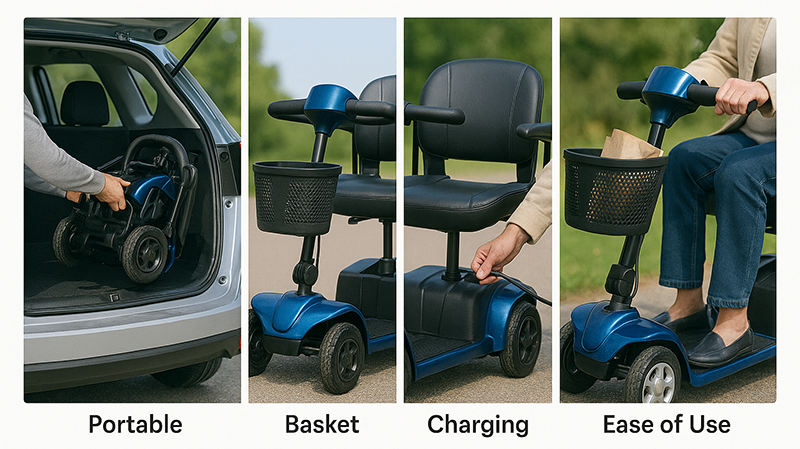
Q4. Which feature would be most helpful for a user needing to transport their scooter in a car boot?
- A) High backrest
- B) Foldable or easily disassembled design
- C) Off-road tyres
- D) Rear view mirrors
🎉 Correct! Foldable scooters or ones that disassemble are much easier to load into car boots or store in smaller spaces.
❌ Incorrect. Backrest comfort isn’t related to transport.
❌ Incorrect. Off-road tyres add bulk, not portability.
❌ Incorrect. Mirrors aid vision, not lifting or storage.
Q5. What is the purpose of the anti-tip wheels on a mobility scooter?
- A) To help users go faster downhill
- B) To make the scooter easier to reverse
- C) To prevent the scooter from tipping backwards
- D) To reduce the turning radius
🎉 Correct! Anti-tip wheels are a critical safety feature that prevent backwards tipping, especially when going up slopes or curbs.
❌ Incorrect. They do not control speed.
❌ Incorrect. They don’t help with reversing.
❌ Incorrect. Turning radius is unrelated to anti-tip features.
Q6. What type of user is a compact or travel scooter best suited for?
- A) Someone needing to drive on rough terrain
- B) Someone who requires a scooter with large batteries
- C) Someone who travels frequently or needs to lift the scooter into a vehicle
- D) Someone who cannot operate any controls
🎉 Correct! Travel scooters are lighter and often foldable or disassemble easily, making them ideal for transport and short-distance trips.
❌ Incorrect. Travel scooters are not suited for uneven or rugged terrain.
❌ Incorrect. Larger batteries are found in mid-size or heavy-duty scooters.
❌ Incorrect. A basic ability to operate controls is needed.
Q7. What is the main advantage of pneumatic (air-filled) tyres on a mobility scooter?
- A) They never need replacing
- B) They offer a smoother, more cushioned ride over uneven surfaces
- C) They help increase top speed
- D) They fold up when not in use
🎉 Correct! Pneumatic tyres absorb bumps and vibrations better than solid tyres, improving comfort over rough ground.
❌ Incorrect. Like all tyres, they wear and may need air or replacement.
❌ Incorrect. Speed is more related to the motor and gearing.
❌ Incorrect. Tyres are not foldable.
Q8. A user needs to drive across gravel or uneven footpaths. What kind of scooter should they consider?
- A) A small travel scooter
- B) A scooter with suspension and larger pneumatic tyres
- C) Any scooter with bright headlights
- D) A folding scooter for quick setup
🎉 Correct! Larger scooters with suspension and bigger wheels provide better stability and ride comfort over bumpy surfaces.
❌ Incorrect. Travel scooters are not designed for rough surfaces.
❌ Incorrect. Headlights improve visibility but not terrain handling.
❌ Incorrect. Folding doesn’t mean better outdoor performance.
Q9. What does the range of a scooter refer to?
- A) The number of gear settings
- B) The battery charging speed
- C) The maximum distance it can travel on a full battery
- D) How far the tiller can turn
🎉 Correct! The scooter’s range tells us how far it can go between charges — an essential factor for planning outings.
❌ Incorrect. Most scooters don’t have gear systems like cars.
❌ Incorrect. Charging speed is a separate specification.
❌ Incorrect. Tiller angle isn’t referred to as range.
Q10. What is one reason a user might choose a 4-wheel scooter over a 3-wheel model?
- A) 4-wheel scooters are usually lighter
- B) They have tighter turning circles
- C) They provide better stability, especially outdoors
- D) 3-wheel scooters are not available anymore
🎉 Correct! 4-wheel scooters are more stable, especially when used outdoors or over uneven ground.
❌ Incorrect. 3-wheel scooters are often lighter.
❌ Incorrect. 3-wheel scooters generally have tighter turns.
❌ Incorrect. 3-wheel scooters are still available in many ranges.
Q11. What does “suspension” on a mobility scooter help with?
- A) Slows the scooter down on hills
- B) Provides a smoother and more comfortable ride over bumps
- C) Increases battery range
- D) Helps lift the scooter into cars
🎉 Correct! Suspension absorbs shocks and vibrations, making the ride more comfortable — especially on uneven ground.
❌ Incorrect. Suspension doesn't control speed.
❌ Incorrect. It doesn’t influence range.
❌ Incorrect. Suspension is unrelated to lifting or transport.
Q12. What safety step should users always take before starting to drive their scooter?
- A) Test the horn
- B) Ensure they are seated properly with the key inserted and brake released
- C) Adjust the mirrors only
- D) Try full throttle immediately
🎉 Correct! Safety involves being seated securely, starting the scooter properly, and being ready to operate it in a controlled way.
❌ Incorrect. While the horn can be useful, it’s not the primary safety step.
❌ Incorrect. Mirrors are helpful but not the key safety check.
❌ Incorrect. Sudden acceleration can be dangerous.
Q13. What does “tiller adjustability” allow in a scooter?
- A) It changes the speed of the scooter
- B) It controls the suspension
- C) It allows the user to reposition the steering column for comfort and access
- D) It unlocks the battery
🎉 Correct! The tiller is the front steering section. Adjustable tilt allows for better reach and ergonomic posture.
❌ Incorrect. Speed is controlled by the throttle, not the tiller angle.
❌ Incorrect. Suspension is a separate feature.
❌ Incorrect. Batteries are accessed separately.
Q14. Which scooter feature best supports night-time or low-light use?
- A) Pneumatic tyres
- B) LED front and rear lights
- C) Rear suspension
- D) Adjustable armrests
🎉 Correct! Front and rear lights help the user see and be seen, especially when driving at dusk or early morning.
❌ Incorrect. Tyres don’t affect visibility.
❌ Incorrect. Suspension improves comfort but not visibility.
❌ Incorrect. Armrests are unrelated to night use.
Q15. What client need might justify choosing a scooter with a captain-style seat?
- A) They prefer faster travel
- B) They require extra comfort and support for longer outings
- C) They need a foldable frame
- D) They have limited hand strength
🎉 Correct! Captain-style seats offer greater support, padding, and postural alignment — ideal for extended trips or users with back issues.
❌ Incorrect. Comfort seating doesn’t affect speed.
❌ Incorrect. These seats are usually on larger, less foldable scooters.
❌ Incorrect. Hand strength is more related to tiller controls.
Q16. What is one key reason a client might need a mid-size or large mobility scooter instead of a compact model?
- A) They only use it indoors
- B) They want a scooter that fits in their handbag
- C) They need higher weight capacity, range, or outdoor performance
- D) They plan to travel by plane often
🎉 Correct! Larger scooters provide more power, stability, and comfort — ideal for longer distances, higher user weights, and outdoor use.
❌ Incorrect. Indoor-only users often choose compact models.
❌ Incorrect. Scooters are not personal carry items like that.
❌ Incorrect. Frequent flyers often prefer lightweight travel models.
Q17. Why is it important to check if a scooter is “airline friendly” before travel?
- A) Airlines charge extra for red scooters
- B) Some scooters use batteries that are not allowed on planes
- C) Scooters can be ridden in the airport terminals
- D) Scooters are only allowed if foldable
🎉 Correct! Airline restrictions often apply to certain lithium battery types, so scooters must be certified for safe air travel.
❌ Incorrect. Scooter colour has no effect on airline policy.
❌ Incorrect. Airport use may be allowed but isn’t the issue here.
❌ Incorrect. Not all airline-approved scooters are foldable.
Q18. What role do delta tillers play in user accessibility?
- A) They make scooters go faster
- B) They allow control using limited hand strength or arthritis-friendly grip
- C) They reduce the need for lights
- D) They enable off-road travel
🎉 Correct! Delta tillers have wraparound handles that can be operated with either hand or palms, great for users with dexterity or grip issues.
❌ Incorrect. They do not increase speed.
❌ Incorrect. Lights are unrelated to tiller shape.
❌ Incorrect. Off-road ability depends on tyres and power, not tiller design.
Q19. Which scooter feature improves safety when stopping on a slope or incline?
- A) Pneumatic tyres
- B) Electromagnetic automatic brakes
- C) Rear-view mirrors
- D) LED indicators
🎉 Correct! Electromagnetic brakes engage automatically when the throttle is released — helping prevent rollback on inclines.
❌ Incorrect. Tyres don’t actively brake the scooter.
❌ Incorrect. Mirrors help with visibility but not braking.
❌ Incorrect. Indicators are for visibility, not incline control.
Q20. What is a key safety reason to slow down when turning a corner on a mobility scooter?
- A) It saves battery power
- B) It helps the user check the time
- C) Turning too fast may cause tipping or loss of control
- D) Slower speeds make it quieter
🎉 Correct! Sudden or sharp turns at high speed increase the risk of tipping, especially on uneven surfaces.
❌ Incorrect. While slower speeds conserve power, safety is the main concern here.
❌ Incorrect. Turning isn’t related to checking the time.
❌ Incorrect. Noise level isn’t the safety issue here.
Q21. Why is ground clearance an important feature to consider in scooter selection?
- A) It tells you how fast the scooter can go
- B) It affects how easily the scooter can drive over curbs or uneven ground
- C) It determines how tall the seat is
- D) It improves battery life
🎉 Correct! Higher ground clearance helps scooters pass over bumps, ramps, and uneven paths without getting stuck or scraping.
❌ Incorrect. Ground clearance is unrelated to speed.
❌ Incorrect. Seat height is adjusted separately from clearance.
❌ Incorrect. Clearance doesn't influence battery life.
Q22. How can mirrors improve safety for mobility scooter users?
- A) They make the scooter look stylish
- B) They improve battery charging
- C) They allow users to see behind them without turning their body
- D) They are required by law
🎉 Correct! Mirrors help users stay aware of surroundings, especially when reversing or navigating shared spaces, reducing strain and risk.
❌ Incorrect. Aesthetic value is not the primary purpose.
❌ Incorrect. Mirrors do not affect battery function.
❌ Incorrect. Legal requirements vary, but they’re mostly recommended for safety.
Q23. What’s the benefit of adjustable armrests on a mobility scooter?
- A) They help lift the scooter
- B) They improve user comfort and allow easier side transfer
- C) They increase top speed
- D) They reduce the scooter’s turning radius
🎉 Correct! Adjustable armrests allow a better fit and enable users to flip up or adjust them for safer transfers on and off the seat.
❌ Incorrect. Armrests do not assist with lifting the unit.
❌ Incorrect. Speed is not affected by armrest type.
❌ Incorrect. Turning is controlled by design and wheelbase.
Q24. What is the main purpose of a freewheel or disengage lever on a scooter?
- A) To let the scooter coast downhill faster
- B) To allow it to be pushed manually if needed
- C) To drain the battery
- D) To activate cruise control
🎉 Correct! The freewheel lever disengages the motor, allowing someone to push the scooter safely (e.g. in an emergency or if it runs flat).
❌ Incorrect. Coasting unsafely is not advised.
❌ Incorrect. It has no link to battery drain.
❌ Incorrect. Freewheel does not control speed modes.
Q25. How does a swivel seat improve accessibility for scooter users?
- A) It allows faster driving
- B) It reduces battery consumption
- C) It helps users get on and off more safely, especially from the side
- D) It improves turning radius
🎉 Correct! Swivel seats rotate to the side, allowing users to transfer more easily — especially helpful for users with hip or leg mobility limits.
❌ Incorrect. Swivel seats don’t affect speed.
❌ Incorrect. Battery usage is unrelated to seating.
❌ Incorrect. Turning radius relates to wheel design.
Q26. Why might a client prefer a scooter with larger wheels?
- A) Larger wheels use less battery
- B) They improve stability and performance on rough or uneven surfaces
- C) Larger wheels make scooters smaller
- D) They allow the scooter to fit in elevators
🎉 Correct! Bigger wheels improve ground clearance and grip, making them ideal for outdoor or rough terrain use.
❌ Incorrect. Battery efficiency is not based on wheel size alone.
❌ Incorrect. Larger wheels typically increase the scooter’s size.
❌ Incorrect. Elevator fit is more about height and width than wheel size.
Q27. What is a common benefit of scooters with front and rear suspension?
- A) They go faster on smooth footpaths
- B) They automatically fold
- C) They reduce vibration and improve comfort on uneven surfaces
- D) They are only suitable indoors
🎉 Correct! Dual suspension absorbs bumps and shocks from uneven surfaces, creating a smoother, safer ride.
❌ Incorrect. Speed depends on motor output, not suspension.
❌ Incorrect. Suspension does not control folding features.
❌ Incorrect. These scooters are typically best outdoors.
Q28. What should staff check when advising a client about scooter weight?
- A) If the scooter can float in water
- B) The scooter’s total weight and whether it can be lifted or transported
- C) How much petrol it uses
- D) Whether the scooter can be used in mud
🎉 Correct! Understanding total weight (including battery) helps determine if a client or carer can lift or transport the scooter.
❌ Incorrect. Scooters are not designed for water use.
❌ Incorrect. Mobility scooters are battery powered, not petrol-fueled.
❌ Incorrect. Mud use is rarely recommended.
Q29. What is a key benefit of scooters with a modular battery system?
- A) Batteries can be removed and charged separately
- B) They increase scooter speed
- C) They make the seat more comfortable
- D) They eliminate the need for wheels
🎉 Correct! Modular battery systems allow batteries to be removed and charged off the scooter, adding flexibility for users with limited access to charging locations.
❌ Incorrect. Speed is unrelated to battery format.
❌ Incorrect. Batteries don’t affect seating comfort.
❌ Incorrect. Scooters still require wheels!
Q30. Why should users avoid exceeding a scooter’s Safe Working Load (SWL)?
- A) It makes the scooter louder
- B) It can cause structural or motor failure and void warranties
- C) It uses more petrol
- D) It makes the seat harder
🎉 Correct! Exceeding SWL risks damage to the frame or motor and can invalidate warranties or cause unsafe operation.
❌ Incorrect. Noise level is not the primary concern.
❌ Incorrect. Scooters are electric, not petrol-based.
❌ Incorrect. Weight doesn’t affect seat density directly.
Q31. What might happen if a scooter’s tyres are under-inflated?
- A) The scooter will go faster
- B) The tyres may wear unevenly and reduce ride comfort or battery efficiency
- C) The horn will stop working
- D) The scooter will automatically stop
🎉 Correct! Low tyre pressure can reduce range, affect comfort, and increase wear on both tyres and motor components.
❌ Incorrect. Low pressure generally slows performance.
❌ Incorrect. The horn is not affected by tyre pressure.
❌ Incorrect. Scooters don't stop automatically from tyre pressure changes alone.
Q32. What should users be advised about storing scooters outdoors?
- A) Scooters are waterproof and fine to leave outside all the time
- B) Scooters should be covered or kept under shelter to protect electrical components
- C) Rain helps clean the scooter
- D) Sunlight makes the battery last longer
🎉 Correct! Scooters have electronic components that should be protected from moisture and prolonged UV exposure when not in use.
❌ Incorrect. While many scooters are weather-resistant, they are not fully waterproof.
❌ Incorrect. Rain exposure can cause damage over time.
❌ Incorrect. Excessive sunlight can degrade components and affect battery life.
Q33. Why is it important to understand turning radius when recommending a scooter?
- A) It shows how far the scooter can go in one battery cycle
- B) It tells you the weight of the scooter
- C) It affects how easily the scooter navigates tight spaces
- D) It increases top speed
🎉 Correct! A tighter turning radius makes it easier to use the scooter in small indoor areas or crowded places.
❌ Incorrect. That describes battery range, not turning.
❌ Incorrect. Turning radius is not linked to weight.
❌ Incorrect. Speed is a separate specification.
Q34. What feature can help users with reduced hand strength safely operate their scooter?
- A) A tighter throttle lever
- B) Non-adjustable tiller
- C) A delta tiller with ergonomic grips and light-touch controls
- D) Manual brakes
🎉 Correct! Delta tillers are designed to be operated with minimal effort using either hand, ideal for users with arthritis or low grip strength.
❌ Incorrect. Tighter levers make operation harder.
❌ Incorrect. Fixed tillers can limit accessibility.
❌ Incorrect. Most scooters use automatic brakes for easier use.
Q35. Why might a scooter with high-back seating be preferred by some users?
- A) It adds speed
- B) It improves head, neck, and trunk support on longer trips
- C) It reduces the need for mirrors
- D) It helps the scooter fit in smaller spaces
🎉 Correct! High-back seats provide improved posture and comfort for users who need additional support, especially during extended use.
❌ Incorrect. The seat doesn’t affect speed.
❌ Incorrect. Seating and mirror use are unrelated.
❌ Incorrect. High-back seats can actually increase scooter size.
Q36. What is the purpose of anti-tip wheels on a mobility scooter?
- A) To make the scooter go faster on inclines
- B) To allow scooter lifting into cars
- C) To prevent the scooter from tipping backward on slopes
- D) To reduce the weight of the scooter
🎉 Correct! Anti-tip wheels are small safety wheels mounted near the back to help prevent tipping backward when going uphill or over curbs.
❌ Incorrect. Anti-tip wheels do not affect speed.
❌ Incorrect. They are not related to lifting or transport.
❌ Incorrect. These wheels slightly increase weight for safety.
Q37. Why is it helpful for scooters to have a front basket or carry solution?
- A) It makes the scooter faster
- B) It allows users to carry personal items hands-free, improving safety
- C) It adds power to the motor
- D) It reduces tyre wear
🎉 Correct! Baskets and storage help users carry items without compromising their control of the scooter.
❌ Incorrect. Speed is unrelated to storage.
❌ Incorrect. Baskets don’t affect motor output.
❌ Incorrect. Tyre wear is not linked to carry solutions.
Q38. What is the benefit of a scooter that disassembles into lightweight parts?
- A) It allows for easier transport in vehicles
- B) It uses petrol more efficiently
- C) It goes faster on hills
- D) It has a higher maximum user weight
🎉 Correct! Travel scooters often disassemble so they can be lifted into car boots without needing a hoist.
❌ Incorrect. Scooters are electric, not petrol-fueled.
❌ Incorrect. Disassembly doesn't affect incline performance.
❌ Incorrect. Weight capacity is a separate spec.
Q39. What does a scooter's “travel range” refer to?
- A) The number of wheels it has
- B) The total height of the seat
- C) The maximum distance it can travel on a full charge
- D) How many baskets it has
🎉 Correct! Travel range is how far the scooter can go under normal conditions before the battery needs recharging.
❌ Incorrect. Number of wheels is unrelated to range.
❌ Incorrect. Seat height is separate from range.
❌ Incorrect. Baskets do not define range.
Q40. Why might a client request indicators and a headlight on their scooter?
- A) To play music
- B) To improve visibility and safety when driving in shared spaces or low-light conditions
- C) To reduce charging time
- D) To stop more quickly
🎉 Correct! Lights and indicators improve safety by making the scooter more visible and allowing users to signal to others — especially outdoors.
❌ Incorrect. These features don’t relate to entertainment.
❌ Incorrect. They do not affect charging.
❌ Incorrect. Braking systems are separate.
Q41. When demonstrating a scooter to a new user, what is essential to explain about the throttle lever?
- A) It only works on hills
- B) The scooter will coast until the brake is applied
- C) Releasing the lever activates the automatic brake
- D) It must be pushed with both hands at once
🎉 Correct! When the throttle lever is released, the scooter will stop using its automatic electromagnetic brake — this is critical for user safety.
❌ Incorrect. The throttle works on all terrain, not just hills.
❌ Incorrect. Scooters don’t coast freely when properly functioning.
❌ Incorrect. The lever can usually be operated with one hand.
Q42. How often should a scooter user check tyre condition and pressure (if applicable)?
- A) Only when something feels wrong
- B) Weekly or before longer outings
- C) Every five years
- D) Tyres never need checking
🎉 Correct! Routine tyre checks help avoid flats, improve ride comfort, and extend battery efficiency — especially before longer trips.
❌ Incorrect. Waiting until something feels wrong is risky.
❌ Incorrect. Five years is far too long.
❌ Incorrect. Tyres require regular care, just like any mobility aid.
Q43. What should be considered when advising a client about scooter seat height?
- A) Seat height has no effect on safety
- B) The higher the seat, the better
- C) Seat height should support safe foot clearance and comfortable transfers
- D) All scooter seats are the same height
🎉 Correct! Seat height should allow the user’s feet to rest comfortably on the footplate and support safe mounting and dismounting.
❌ Incorrect. Seat height can impact both safety and usability.
❌ Incorrect. Too high a seat may hinder safe transfers.
❌ Incorrect. Scooter seats vary by model and adjustability.
Q44. Why should clients be shown how to charge the scooter battery correctly?
- A) Incorrect charging can shorten battery life or cause faults
- B) So they can jump-start it if needed
- C) To make it faster
- D) Charging isn’t necessary on modern scooters
🎉 Correct! Safe, regular charging using the correct port and timing helps maximise battery lifespan and ensures consistent performance.
❌ Incorrect. Jump-starting isn’t applicable for mobility scooters.
❌ Incorrect. Charging won’t affect scooter speed.
❌ Incorrect. Charging remains essential regardless of scooter age.
Q45. What is the purpose of reflectors and high-visibility accents on some scooter models?
- A) To improve the scooter’s resale value
- B) To help the scooter blend in
- C) To make the scooter more visible to others, improving safety
- D) They are only decorative
🎉 Correct! Reflectors and bright colours improve visibility, especially in low-light conditions or shared paths, helping prevent accidents.
❌ Incorrect. Safety is the main reason, not resale.
❌ Incorrect. The goal is to stand out, not blend in.
❌ Incorrect. These features serve a safety purpose.
Q46. What does Safe Working Load (SWL) include when checking scooter suitability?
- A) Only the user’s body weight
- B) The combined weight of the user and any carried items
- C) Just the scooter’s battery weight
- D) The height of the scooter
🎉 Correct! SWL includes the user's weight plus items like shopping bags, backpacks, or oxygen tanks.
❌ Incorrect. Accessories and carried loads must be considered.
❌ Incorrect. SWL does not refer to battery weight.
❌ Incorrect. Height is unrelated to weight capacity.
Q47. What does a tiller adjustment feature allow the user to do?
- A) Charge the scooter
- B) Fold the wheels under the base
- C) Change the angle or position of the steering column
- D) Increase the speed of the scooter
🎉 Correct! Adjustable tillers help users position the controls for comfort, especially for those with limited reach or trunk mobility.
❌ Incorrect. Charging is handled separately.
❌ Incorrect. Tiller adjustments do not affect wheels.
❌ Incorrect. Speed is adjusted via throttle, not tiller angle.
Q48. What’s one reason a client might choose a 4-wheel scooter over a 3-wheel model?
- A) 4-wheel scooters are always smaller
- B) 4-wheel scooters tend to offer more stability, especially outdoors
- C) 3-wheel scooters can’t be used on ramps
- D) 4-wheel scooters charge faster
🎉 Correct! 4-wheel scooters provide extra balance and traction, which can be especially useful on rough or uneven ground.
❌ Incorrect. 4-wheel models are often larger.
❌ Incorrect. 3-wheel scooters can be ramp-compatible too.
❌ Incorrect. Charging times depend on battery type, not wheels.
Q49. What should users avoid when operating a mobility scooter on uneven surfaces?
- A) Going slowly and carefully
- B) Taking sharp turns at speed or climbing steep kerbs
- C) Using anti-tip wheels
- D) Keeping both hands on the controls
🎉 Correct! High-speed turning and steep climbs can lead to tipping — users should always approach uneven terrain cautiously.
❌ Incorrect. Caution is appropriate for bumpy areas.
❌ Incorrect. Anti-tip wheels are a safety feature.
❌ Incorrect. Both hands should remain on the tiller for control.
Q50. Why should staff check scooter width when assisting with product selection?
- A) To ensure it fits through the client’s common accessways, doors, and ramps
- B) Because narrower scooters are faster
- C) So the scooter can float in water
- D) It doesn’t matter – all scooters fit everywhere
🎉 Correct! Width determines whether the scooter can pass through doorways, narrow hallways, or lifts — critical for indoor use or transport access.
❌ Incorrect. Width doesn’t affect speed directly.
❌ Incorrect. Scooters should not be used in water.
❌ Incorrect. Access needs vary by home and location.