Staff Knowledge Check
Test your understanding with real-life scenario questions. Great for team discussion or self-check.
Q1. What is the main purpose of using a rollator or walker?
- A) To increase walking speed
- B) To support balance, safety, and mobility
- C) To replace a wheelchair
- D) To carry personal items only
🎉 Correct! Rollators and walkers are mobility aids designed to support users with reduced balance, stability, or endurance while walking.
❌ Incorrect. Speed is not the goal — safety and support are.
❌ Incorrect. They assist walking, not replace it like a wheelchair.
❌ Incorrect. Many have storage, but that's not their primary function.
Q2. How should the handles of a rollator or walker be adjusted?
- A) At shoulder height
- B) Just below the user's wrist
- C) At the height of the elbows when fully bent
- D) The same height for all users
🎉 Correct! Handles should align with the user's wrists when their arms are relaxed by their sides, allowing a slight bend at the elbows.
❌ Incorrect. Handles set too high can reduce control and safety.
❌ Incorrect. Elbows should be slightly bent, not fully.
❌ Incorrect. Handle height should be adjusted to each user's needs.
Q3. What is one key difference between a rollator and a walking frame (without wheels)?
- A) Rollators require more lifting
- B) Walking frames have built-in seats
- C) Rollators roll forward and include brakes
- D) Walking frames are faster to use
🎉 Correct! Rollators have wheels and brakes for continuous walking, while walking frames are lifted and placed forward.
❌ Incorrect. Walking frames require lifting, not rollators.
❌ Incorrect. Rollators typically include a seat, not walking frames.
❌ Incorrect. Rollators are often faster due to their rolling motion.
Q4. Why is brake function important in a rollator?
- A) It helps users carry heavier items
- B) It keeps the user moving faster
- C) It improves stability when walking or sitting
- D) It makes the rollator more colourful
🎉 Correct! Brakes are essential for safety, preventing movement when stopping or sitting.
❌ Incorrect. Brakes don’t affect item capacity.
❌ Incorrect. Brakes are for control, not speed.
❌ Incorrect. Safety, not appearance, is the purpose.
Q5. Who is most likely to benefit from using a rollator instead of a walking stick?
- A) A client with good balance and no fatigue
- B) A client with mild joint pain only
- C) A client needing both balance support and a place to rest
- D) A client using a wheelchair full-time
🎉 Correct! Rollators provide both walking assistance and a seat, ideal for clients who fatigue easily or need more support.
❌ Incorrect. This client may not need a rollator.
❌ Incorrect. A stick may be sufficient for mild pain if balance is good.
❌ Incorrect. Full-time wheelchair users may not benefit from a rollator.
Q6. When choosing a walker or rollator, why is wheel size important?
- A) Larger wheels make the walker taller
- B) Smaller wheels help users walk faster
- C) Larger wheels provide better performance on uneven surfaces
- D) Wheel size is purely for aesthetics
🎉 Correct! Larger wheels offer greater stability and ease when navigating rough or outdoor terrain.
❌ Incorrect. Wheel size affects movement, not user height.
❌ Incorrect. Speed is not improved by smaller wheels.
❌ Incorrect. Wheel size affects function more than appearance.
Q7. What is a key safety feature to check before a client uses their rollator for the first time?
- A) That the wheels match the floor colour
- B) That the seat cushion is warm
- C) That the brakes engage and release properly
- D) That the client can carry items with it
🎉 Correct! Brake checks are essential for user safety during walking and sitting.
❌ Incorrect. Floor colour has no bearing on use.
❌ Incorrect. Seat temperature is irrelevant to safety.
❌ Incorrect. Storage is secondary to safety checks.
Q8. What is the benefit of a rollator with a built-in seat?
- A) It improves speed when walking
- B) It allows the user to rest when needed
- C) It makes the walker heavier
- D) It adds more colour options
🎉 Correct! A seat is valuable for users who fatigue easily and may need to stop and rest during longer outings.
❌ Incorrect. Seats don’t affect walking speed.
❌ Incorrect. Added weight is not a benefit in most cases.
❌ Incorrect. Function, not appearance, is the purpose of a seat.
Q9. Which feature helps a rollator user maintain posture and comfort while walking?
- A) Height-adjustable handles
- B) Cup holder
- C) Wide frame width
- D) Extra storage capacity
🎉 Correct! Proper handle height helps users maintain upright posture, reducing strain on the shoulders and back.
❌ Incorrect. Cup holders add convenience but don’t affect posture.
❌ Incorrect. Width may impact stability, but not posture directly.
❌ Incorrect. Storage is helpful, but posture depends on fit.
Q10. What is a risk if the walker frame is too wide for a client’s home environment?
- A) The walker will go too fast
- B) The user may struggle to turn corners or pass through doorways
- C) The wheels will fall off
- D) It increases the battery usage
🎉 Correct! Oversized frames may make it difficult to safely navigate tight areas or doorways, increasing the risk of bumps and falls.
❌ Incorrect. Frame width doesn’t control speed.
❌ Incorrect. A properly maintained walker won’t lose wheels.
❌ Incorrect. Walkers aren’t battery-powered unless they're powered wheelchairs.
Q11. Why is regular maintenance important for mobility walkers and rollators?
- A) To ensure fashion trends are followed
- B) To prevent squeaky noises
- C) To ensure brakes, wheels, and folding parts function safely
- D) To make it lighter to carry
🎉 Correct! Regular checks ensure key safety components like brakes, wheels, and hinges work properly and reduce risk of injury.
❌ Incorrect. Safety, not fashion, is the priority.
❌ Incorrect. Noise may be a sign of issues, but function is the concern.
❌ Incorrect. Maintenance does not reduce product weight.
Q12. What is a good way to assess if a rollator is appropriately sized for the user?
- A) Their elbows are bent about 15–30° when holding the handles
- B) Their feet dangle above the ground when seated
- C) Their shoulders are raised when pushing it
- D) The handles are below the knees
🎉 Correct! A slight bend at the elbow with relaxed arms is ideal for comfort and posture when walking with a rollator.
❌ Incorrect. The user should be able to sit with feet flat on the ground.
❌ Incorrect. Raised shoulders suggest the rollator is too tall.
❌ Incorrect. Handles below knee level are unsafe and uncomfortable.
Q13. What client goal may suggest a rollator is better than a basic walking frame?
- A) To walk independently outdoors for longer distances
- B) To walk only short distances with assistance
- C) To move around the bed at night
- D) To transition to using a wheelchair
🎉 Correct! Rollators are ideal for users who walk independently and want support over longer distances, especially outdoors.
❌ Incorrect. A walking frame may be more appropriate for very short distances or full supervision.
❌ Incorrect. Rollators are not suited to use in confined spaces like around a bed.
❌ Incorrect. Rollators assist walking, not wheelchair transitions.
Q14. What role does a cane holder or accessory attachment play in rollator use?
- A) It increases the user's weight limit
- B) It allows personalisation for fashion
- C) It improves the user's independence when switching aids
- D) It adds noise reduction
🎉 Correct! A cane holder helps users store their walking stick while using the rollator, supporting smooth transitions between mobility aids.
❌ Incorrect. Accessories don’t affect weight capacity.
❌ Incorrect. Accessories may have visual appeal, but that’s not their primary purpose.
❌ Incorrect. Cane holders don’t reduce noise.
Q15. A client is concerned about uneven paths and requires an all-terrain rollator. What should you check when recommending a walker?
- A) Whether it includes a food tray
- B) The seat height and colour options
- C) The frame material and folding size
- D) The wheel size, tread, and stability features
🎉 Correct! Large wheels, treaded tyres, and a stable frame are essential for all-terrain use. Always check this before recommending.
❌ Incorrect. A food tray isn’t relevant to terrain use.
❌ Incorrect. These are comfort and aesthetic features, not terrain-focused.
❌ Incorrect. Folding and frame material matter, but wheels and stability are more important for outdoor use.
Q16. What makes a rollator more suitable than a frame for outdoor use?
- A) Smaller wheels and no brakes
- B) Lightweight plastic frame
- C) Large wheels and braking system
- D) Attached drink bottle holder
🎉 Correct! Larger wheels help handle uneven terrain, and brakes provide control on slopes and rough surfaces.
❌ Incorrect. Small wheels and no brakes are unsafe outdoors.
❌ Incorrect. Frame material is less important than stability and control.
❌ Incorrect. Accessories do not determine outdoor suitability.
Q17. Why might a 4-wheeled rollator be better for someone who fatigues quickly?
- A) It can be used to push them like a wheelchair
- B) It has a seat for rest breaks
- C) It reduces arm fatigue by forcing faster walking
- D) It can be used as a ladder
🎉 Correct! The seat offers a safe and convenient place to rest if walking long distances causes fatigue.
❌ Incorrect. Rollators are not meant to carry people like a wheelchair.
❌ Incorrect. Speed should be user-controlled, not forced.
❌ Incorrect. A rollator is never safe to use as a ladder.
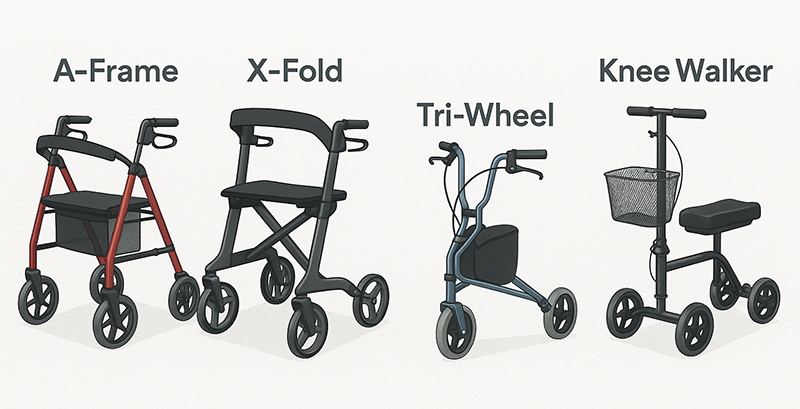
Q18. When would a tri-wheel walker (3-wheeled) be preferable to a 4-wheeled rollator?
- A) When the user needs extra storage space
- B) When better maneuverability in tight spaces is needed
- C) When the user cannot use brakes
- D) When outdoor use on rough terrain is required
🎉 Correct! Tri-wheel walkers are lighter and easier to turn, which helps in confined indoor areas like hallways.
❌ Incorrect. 4-wheeled rollators typically have more storage.
❌ Incorrect. Tri-wheeled walkers still require brake use.
❌ Incorrect. 4-wheeled all-terrain models are better outdoors.
Q19. What is the benefit of a rollator that folds side-to-side (not front-to-back)?
- A) It becomes taller when folded
- B) It is easier to lift overhead
- C) It remains standing when folded
- D) It cannot be stored in small spaces
🎉 Correct! Side-fold rollators often remain upright when folded, making them easier to store and safer to handle.
❌ Incorrect. Folding does not increase height.
❌ Incorrect. Folding direction does not improve lifting ease.
❌ Incorrect. These models are often designed to save space.
Q20. What factor is most important when choosing a rollator for a bariatric client?
- A) Colour and design preferences
- B) High weight capacity and wide seat
- C) Whether it has three wheels
- D) If it folds in half
🎉 Correct! A rollator for a bariatric user should have a reinforced frame, wide seat, and appropriate weight capacity.
❌ Incorrect. Aesthetics are secondary to safety and support.
❌ Incorrect. Tri-wheel models typically have lower capacity and stability.
❌ Incorrect. Folding style is less critical than strength and width.
Q21. Why is it important to test the brakes on a rollator regularly?
- A) To prevent scratches on the wheels
- B) To ensure proper control and safety
- C) To adjust the walking speed
- D) To reduce tyre noise
🎉 Correct! Brake performance is crucial for user control, especially when sitting down or using the rollator on slopes.
❌ Incorrect. Scratches are cosmetic, not safety-related.
❌ Incorrect. Brakes are not used to adjust walking pace.
❌ Incorrect. Noise is not the primary concern.
Q22. What should a staff member consider when showing a rollator to a client with shoulder arthritis?
- A) That it’s the lightest colour available
- B) That the seat is extra deep
- C) That it has ergonomic handles and smooth brakes
- D) That it does not fold
🎉 Correct! Ergonomic, padded handles and brakes that are easy to engage can reduce strain on arthritic joints.
❌ Incorrect. Colour has no clinical relevance.
❌ Incorrect. Seat depth is not the key consideration here.
❌ Incorrect. Foldability may still be useful for transport.
Q23. Why is the ability to lock brakes important when using a rollator?
- A) So the wheels don’t overheat
- B) To prevent the user from rolling while sitting
- C) To improve turn radius
- D) To change handle height
🎉 Correct! Locking brakes ensures stability when the user sits down or stands up from the seat, preventing movement and reducing fall risk.
❌ Incorrect. Brakes are not used for wheel temperature control.
❌ Incorrect. Turning radius depends on design, not brakes.
❌ Incorrect. Handle height is adjusted separately.
Q24. A client lives in a small apartment with narrow hallways. What feature should their walker include?
- A) A very wide base
- B) Large, off-road wheels
- C) A narrow frame and tight turning radius
- D) Fixed rear legs
🎉 Correct! Compact walkers with smaller turning circles are easier to use in tight indoor spaces.
❌ Incorrect. A wide base can make navigating small spaces harder.
❌ Incorrect. Off-road wheels are better suited to outdoor use.
❌ Incorrect. Fixed legs reduce mobility and maneuverability.
Q25. Why should the seat height on a rollator be considered during selection?
- A) It changes the colour options
- B) It affects how easily the user can stand and sit
- C) It determines how fast the rollator moves
- D) It increases the wheel durability
🎉 Correct! Seat height needs to match the user's leg length for safe sitting and standing.
❌ Incorrect. Seat height doesn’t impact style or colour choices.
❌ Incorrect. Speed is controlled by the user, not seat height.
❌ Incorrect. Durability relates to materials, not seat height.
Q26. What is the role of a cane holder attachment on a rollator?
- A) It helps push the rollator faster
- B) It is used to store medication
- C) It allows users to carry their cane when not in use
- D) It is required for all NDIS participants
🎉 Correct! A cane holder lets users securely store their walking stick while using the rollator.
❌ Incorrect. The holder doesn’t affect movement speed.
❌ Incorrect. Medication storage is not its purpose.
❌ Incorrect. It’s helpful, but not mandatory.
Q27. What does "anti-tip" design mean in the context of rollators?
- A) It prevents the brakes from engaging
- B) It reduces the chance of the rollator tipping over
- C) It blocks the wheels from moving backwards
- D) It makes the seat lower to the ground
🎉 Correct! Anti-tip features enhance stability to prevent accidental falls or rollator tipping.
❌ Incorrect. It doesn’t interfere with brakes.
❌ Incorrect. That would reduce usability, not improve safety.
❌ Incorrect. Seat height is separate from anti-tip features.
Q28. What type of client might benefit from a rollator with a high weight capacity?
- A) A child recovering from surgery
- B) A person with limited hand strength
- C) A bariatric client needing extra frame support
- D) A person who only needs occasional walking support
🎉 Correct! Bariatric clients require rollators that can safely support their weight and provide a wider seat for comfort.
❌ Incorrect. Paediatric users would need a smaller frame.
❌ Incorrect. That’s more relevant to brake design, not capacity.
❌ Incorrect. Occasional use may not require bariatric features.
Q29. When folding a rollator for transport, what should staff check?
- A) That the brakes are locked and no items are stored
- B) That the wheels are removed first
- C) That the user has their walking stick on hand
- D) That the seat height has been lowered
🎉 Correct! Ensure brakes are locked, no loose items are stored, and the folding mechanism engages safely.
❌ Incorrect. Most rollators don’t require wheel removal to fold.
❌ Incorrect. Useful, but not essential to safe folding.
❌ Incorrect. Seat height doesn’t usually affect folding.
Q30. What is the benefit of height-adjustable handles on a walker?
- A) Allows for faster walking
- B) Ensures a correct ergonomic fit for each user
- C) Improves seat comfort
- D) Helps fold the walker more easily
🎉 Correct! Proper handle height ensures safer posture, better control, and reduced strain on the shoulders and wrists.
❌ Incorrect. It’s about posture, not speed.
❌ Incorrect. Handle height doesn’t affect seat comfort.
❌ Incorrect. Folding is a separate feature.
Q31. What client condition might require a rollator with forearm supports?
- A) Strong upper body strength
- B) Short-term fatigue
- C) Limited grip or wrist weakness
- D) Good balance and posture
🎉 Correct! Forearm supports are designed for clients with poor grip strength, arthritis, or neurological conditions affecting wrist stability.
❌ Incorrect. These supports are for those who cannot rely on arm strength alone.
❌ Incorrect. Short-term fatigue doesn’t usually require forearm supports.
❌ Incorrect. These users may not need additional supports.
Q32. What feature on a rollator helps reduce the risk of tripping on uneven ground?
- A) A folding frame
- B) Large front wheels
- C) Soft foam seat
- D) Cup holder
🎉 Correct! Larger front wheels can roll over uneven surfaces and small obstacles more safely than smaller ones.
❌ Incorrect. Folding is useful for storage, not terrain.
❌ Incorrect. Seat material doesn’t help with walking safety.
❌ Incorrect. A cup holder doesn’t impact stability outdoors.
Q33. Why should staff demonstrate how to engage the brakes on a rollator during handover?
- A) To reduce the likelihood of a return
- B) To ensure the user can stop and sit safely
- C) To adjust the colour of the handles
- D) To set a walking speed limit
🎉 Correct! Teaching correct brake use is critical to preventing falls and ensuring the user can safely control the aid.
❌ Incorrect. The goal is client safety, not returns.
❌ Incorrect. Brakes don’t affect colour.
❌ Incorrect. Speed isn’t controlled by brakes like in a car.
Q34. What situation might require a user to consider a non-wheeled walking frame instead of a rollator?
- A) They need to walk long distances outdoors
- B) They have poor balance and need slow, supported walking
- C) They want to carry shopping bags
- D) They have a large vehicle for transport
🎉 Correct! Walking frames provide slower, stable progression and are suited for those who struggle with control or balance.
❌ Incorrect. Rollators are generally better for outdoor distances.
❌ Incorrect. Rollators with bags are better for carrying items.
❌ Incorrect. Transport space doesn’t dictate walker type alone.
Q35. Why is it important that the user's gait is observed when selecting a walking aid?
- A) So the staff can choose the most attractive style
- B) To determine the user’s favourite walking path
- C) To match the device to their movement pattern and balance needs
- D) To find the right shoe size
🎉 Correct! Gait observation helps match the client to a device that supports their stride, posture, and safety needs.
❌ Incorrect. Style is not a clinical requirement.
❌ Incorrect. Location preference is not relevant.
❌ Incorrect. Shoe fitting is unrelated to walking aid selection.
Q36. What is the purpose of reflective components on some rollators?
- A) To make them look more stylish
- B) To help with folding at night
- C) To improve visibility in low-light environments
- D) To brighten indoor spaces
🎉 Correct! Reflective strips or components increase the user’s visibility and safety when walking near roads or in poorly lit areas.
❌ Incorrect. Appearance is secondary to safety.
❌ Incorrect. Reflectors are not for folding guidance.
❌ Incorrect. Reflectors don’t enhance ambient lighting.
Q37. What should staff check before recommending a rollator to a client for community access?
- A) That it fits in their garden shed
- B) That it has large wheels, strong brakes, and a seat
- C) That it is brightly coloured
- D) That it has the highest weight capacity possible
🎉 Correct! Outdoor/community use rollators should be durable, include a seat for rest, and have reliable wheels and brakes for variable terrain.
❌ Incorrect. Storage location is less important than function.
❌ Incorrect. Colour is not a clinical requirement.
❌ Incorrect. Weight capacity should match the individual, not be maximised unnecessarily.
Q38. What is the benefit of a rollator with a built-in bag or basket?
- A) It makes the walker more expensive
- B) It prevents the rollator from folding
- C) It allows users to carry items hands-free
- D) It makes the walker heavier for exercise
🎉 Correct! Integrated bags or baskets help users transport personal items safely without affecting their grip or posture.
❌ Incorrect. Price is not the key factor.
❌ Incorrect. Most bags are removable or foldable with the frame.
❌ Incorrect. Weight should not be added unnecessarily.
Q39. A client says their rollator feels too wide in their hallway. What could be a solution?
- A) Recommend a smaller-width rollator or a tri-wheel walker
- B) Encourage the client to move house
- C) Suggest using the rollator sideways
- D) Advise them to fold it while walking
🎉 Correct! Narrower rollators or tri-wheel walkers are designed for tighter spaces and improved indoor maneuverability.
❌ Incorrect. That’s not a practical recommendation.
❌ Incorrect. Walking sideways with a rollator is unsafe.
❌ Incorrect. Rollators should never be walked with while folded.
Q40. Why might a rollator with an adjustable backrest be preferred for some users?
- A) It adds extra colour options
- B) It provides custom comfort and posture when seated
- C) It reduces the overall weight of the frame
- D) It improves brake function
🎉 Correct! Adjustable backrests support comfort and posture when users stop to rest, especially for prolonged seating.
❌ Incorrect. Backrests don’t influence style options.
❌ Incorrect. Adjustable features may actually add weight.
❌ Incorrect. Brakes are separate from backrest design.
Q41. What safety risk may arise if a rollator is set too high for the user?
- A) The user may walk faster
- B) It may improve back posture
- C) It may cause shoulder strain and instability
- D) It will reduce the need for brakes
🎉 Correct! If the handles are too high, it can cause poor arm positioning, strain, and reduce balance control.
❌ Incorrect. Height does not influence walking speed directly.
❌ Incorrect. Incorrect height usually worsens posture.
❌ Incorrect. Proper braking is always necessary regardless of handle height.
Q42. What key feature allows a rollator to be transported easily in a vehicle?
- A) A built-in GPS
- B) A collapsible or folding frame
- C) Wide wheels for off-road use
- D) A fixed rigid frame
🎉 Correct! Folding designs reduce the space required for transport and make it easier for carers or clients to lift the device into a car.
❌ Incorrect. GPS is not standard or necessary for transport.
❌ Incorrect. Off-road wheels may add bulk and weight.
❌ Incorrect. Fixed frames are less practical for transport.
Q43. What client group might require a compact or travel-style rollator?
- A) Clients with limited home storage or frequent travel needs
- B) Clients who live on farms
- C) Clients with no mobility issues
- D) Clients using a wheelchair full time
🎉 Correct! Compact models are ideal for people who need lightweight, foldable designs that are easy to lift, store, and pack into cars or planes.
❌ Incorrect. Terrain suitability is a better fit for rugged rollators, not compact ones.
❌ Incorrect. Rollators are generally for those with mobility needs.
❌ Incorrect. Full-time wheelchair users may not need a rollator.
Q44. What role does a padded seat play in a rollator’s design?
- A) Makes it easier to roll uphill
- B) Provides comfort during rest breaks
- C) Helps lock the brakes
- D) Prevents it from folding accidentally
🎉 Correct! A padded seat ensures the user can take comfortable rest breaks, particularly when walking longer distances.
❌ Incorrect. Seat padding does not impact terrain use.
❌ Incorrect. The brakes are operated separately from the seat.
❌ Incorrect. Seat design does not affect folding mechanism.
Q45. What should be considered when fitting a rollator for a tall user?
- A) The width of the seat
- B) The colour of the wheels
- C) The maximum handle height adjustment
- D) The weight of the rollator
🎉 Correct! Tall users need a rollator with higher handle adjustability to maintain upright posture and avoid strain.
❌ Incorrect. Seat width is more important for broader users, not taller ones.
❌ Incorrect. Wheel colour is not clinically relevant.
❌ Incorrect. While relevant, weight is less important than handle height for tall users.
Q46. What is the benefit of a dual-fold rollator design?
- A) It has more wheels than usual
- B) It folds both lengthwise and widthwise for easier transport and storage
- C) It reduces the need for a seat
- D) It improves brake strength
🎉 Correct! Dual-fold designs increase portability by collapsing in more than one direction, making them ideal for travel or small storage spaces.
❌ Incorrect. Wheel count is unrelated to the fold type.
❌ Incorrect. Fold style doesn’t eliminate the need for seating.
❌ Incorrect. Brake performance is separate from folding style.
Q47. Why might a client need a rollator with both seat and backrest?
- A) For postural support during rest breaks
- B) To carry groceries
- C) To help stand up more easily
- D) To push faster
🎉 Correct! Backrests give added comfort and postural support for users who need to rest regularly while walking.
❌ Incorrect. Baskets or bags are used for carrying items.
❌ Incorrect. The backrest supports resting, not standing assistance.
❌ Incorrect. A backrest doesn’t influence walking speed.
Q48. What is a key risk if a user does not lock the brakes before sitting on a rollator?
- A) The rollator may collapse
- B) The seat will become uncomfortable
- C) The rollator may move, causing a fall
- D) The brakes will wear out faster
🎉 Correct! Not locking brakes before sitting creates a major fall risk as the rollator may slide out from under the user.
❌ Incorrect. Modern rollators don’t collapse when seated on.
❌ Incorrect. Comfort isn’t the key concern — safety is.
❌ Incorrect. Brake wear is not the primary safety issue here.
Q49. What does “ergonomic handgrip” mean in rollator design?
- A) It’s made of metal
- B) It has a unique brand logo
- C) It is shaped to support natural wrist and hand position
- D) It folds away
🎉 Correct! Ergonomic handgrips reduce strain by supporting natural wrist alignment and increasing comfort during use.
❌ Incorrect. Material doesn’t define ergonomic function alone.
❌ Incorrect. Logos have no clinical impact.
❌ Incorrect. Ergonomics refers to shape and comfort, not foldability.
Q50. How can staff ensure a rollator is the right size for a new client?
- A) Ask the client to measure their shoe size
- B) Check height and posture with a trial and adjust handle height accordingly
- C) Choose the lightest rollator available
- D) Select a model based on the client’s age
🎉 Correct! Staff should help the client trial a rollator, adjust the handle height, and observe gait and posture to ensure a correct fit.
❌ Incorrect. Shoe size is not relevant to rollator fit.
❌ Incorrect. Weight is only one factor to consider.
❌ Incorrect. Age alone doesn’t determine equipment needs.