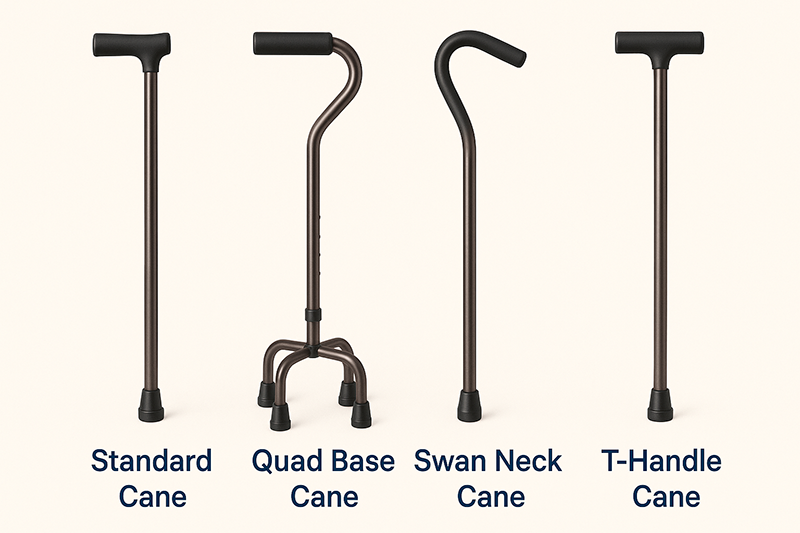
Staff Knowledge Check
Test your understanding with real-life scenario questions. Great for team discussion or self-check.
Q1. What is the main clinical purpose of a walking stick?
- A) To carry groceries
- B) To improve fashion and style
- C) To provide balance and reduce the risk of falls
- D) To replace a wheelchair
🎉 Correct! Walking sticks assist with balance, posture, and reducing fall risk, particularly for individuals with minor mobility impairments.
❌ Incorrect. They're not designed to carry items.
❌ Incorrect. Style may vary, but function is the focus.
❌ Incorrect. Walking sticks support light mobility—not full substitution for wheelchairs.
Q2. Which feature allows a walking stick to be suitable for users of different heights?
- A) It comes in multiple colours
- B) A telescopic or height-adjustable shaft
- C) The type of handle
- D) The presence of a wrist strap
🎉 Correct! Height-adjustable shafts allow for customisation to the user's arm length and walking posture, improving safety and comfort.
❌ Incorrect. Colour doesn’t impact adjustability.
❌ Incorrect. Handle type affects grip, not height.
❌ Incorrect. Wrist straps improve handling but not sizing.
Q3. Which type of handle is best suited for users with reduced grip strength or arthritis?
- A) Straight wooden handle
- B) Ergonomic or comfort grip handle
- C) T-bar handle
- D) Decorative metal knob
🎉 Correct! Ergonomic and comfort grip handles reduce hand strain and improve pressure distribution—ideal for long-term use or joint conditions.
❌ Incorrect. Straight handles offer less support for weak grip.
❌ Incorrect. T-bars are standard but not optimised for arthritis.
❌ Incorrect. Decorative knobs lack comfort and support.
Q4. What is the main function of a walking stick ferrule (tip)?
- A) To look stylish
- B) To make the stick taller
- C) To improve grip and reduce slipping
- D) To attach a flashlight
🎉 Correct! Ferrules are rubber or non-slip tips that create ground friction and stability, essential for safe walking.
❌ Incorrect. Style isn’t the key function.
❌ Incorrect. Height is adjusted via the shaft, not the tip.
❌ Incorrect. Flashlight attachments are not standard or typical.
Q5. When is it appropriate to recommend a quad base walking stick?
- A) When the client needs increased stability and support over a standard stick
- B) When the user prefers to walk faster
- C) For climbing stairs only
- D) For short-term post-operative care
🎉 Correct! Quad canes offer greater ground contact and are ideal for clients needing extra support, especially with balance issues or hemiplegia.
❌ Incorrect. Quad bases may slightly slow pace due to their stability.
❌ Incorrect. They are more awkward on stairs than single-point sticks.
❌ Incorrect. Standard sticks may suffice for short-term needs.
Q6. How should a walking stick be positioned during normal use for optimal support?
- A) On the same side as the injured leg
- B) On the opposite side of the weaker or injured leg
- C) In front of both feet at all times
- D) Alternated between hands constantly
🎉 Correct! The stick is generally used on the stronger side to offload and support the opposite weaker side during walking.
❌ Incorrect. This can reduce stability and increase strain.
❌ Incorrect. The stick should move naturally with the step cycle.
❌ Incorrect. Alternating randomly is not safe or recommended.
Q7. Why might a folding walking stick be recommended for some clients?
- A) It looks nicer than standard models
- B) It can be stored compactly when not in use
- C) It is heavier and more stable
- D) It includes GPS tracking
🎉 Correct! Folding sticks are great for users who only need occasional support and want to carry the stick discreetly when not walking.
❌ Incorrect. Appearance isn’t the main benefit.
❌ Incorrect. Folding sticks are generally lighter, not heavier.
❌ Incorrect. Most sticks do not include tech features like GPS.
Q8. What is a swan-neck walking stick designed to offer?
- A) Decorative styling
- B) Weight distribution directly over the shaft for better control
- C) A longer reach for tall users
- D) Extra cushioning in the handle
🎉 Correct! Swan-neck sticks shift the user’s weight vertically through the shaft, improving balance and reducing strain on the wrist.
❌ Incorrect. The curve serves a biomechanical purpose, not aesthetics.
❌ Incorrect. Height is adjusted separately from the neck style.
❌ Incorrect. Handle padding is not the defining feature of swan-neck designs.
Q9. What is a safe way to confirm if a walking stick height is correct for a user?
- A) The handle should reach their knee
- B) The user’s arm should be fully straight
- C) The user’s elbow should be slightly bent (approx. 15–20°) when holding the handle
- D) It should be taller than their waist
🎉 Correct! A slight bend in the elbow ensures ergonomic use and proper support during ambulation.
❌ Incorrect. Knee height is too low.
❌ Incorrect. A fully straight arm reduces control and shock absorption.
❌ Incorrect. Waist height is too high for safe use.
Q10. What is the main reason to regularly check the ferrule on a walking stick?
- A) To make sure it still matches the stick’s colour
- B) To check if it’s collecting dirt
- C) To ensure it is not worn out or smooth, which would reduce grip
- D) To see if it needs to be oiled
🎉 Correct! Worn ferrules lose their grip and can become dangerous on wet or smooth surfaces. They should be replaced if smooth or cracked.
❌ Incorrect. Colour matching is not a safety concern.
❌ Incorrect. While cleaning helps, safety is the main concern.
❌ Incorrect. Ferrules don’t require oiling.
Q11. Which user is most likely to benefit from a walking stick with a seat?
- A) Someone who enjoys running
- B) Someone who is frequently mobile and needs brief rest breaks when out
- C) Someone who only uses the stick indoors
- D) Someone who prefers a wide grip
🎉 Correct! Stick-seats are helpful for clients who need periodic sitting support when walking or waiting in queues.
❌ Incorrect. Running would not require a stick at all.
❌ Incorrect. Indoor-only users likely have other furniture available.
❌ Incorrect. Grip style isn’t the defining feature of seat sticks.
Q12. Why is a wrist strap a valuable safety feature on a walking stick?
- A) It makes the stick look more professional
- B) It prevents the stick from falling if the user lets go temporarily
- C) It helps reduce the stick's weight
- D) It controls the height adjustment
🎉 Correct! A wrist strap keeps the stick secure and close to the user, reducing drop risk and the need to bend down.
❌ Incorrect. Appearance isn’t the main concern.
❌ Incorrect. Straps do not affect the stick’s weight.
❌ Incorrect. Straps are not used for adjusting stick height.
Q13. Which feature of a walking stick helps prevent wrist strain during extended use?
- A) Metal shaft
- B) Wrist strap
- C) Ergonomic or orthopaedic handle
- D) Bright colour
🎉 Correct! Ergonomic handles distribute pressure more evenly, reducing joint stress and improving comfort.
❌ Incorrect. Shaft material has minimal impact on wrist comfort.
❌ Incorrect. Straps help with retention, not pressure relief.
❌ Incorrect. Colour doesn't affect wrist comfort.
Q14. What does it mean if a walking stick is described as "left or right handed"?
- A) It can only be used with one hand at a time
- B) The handle is contoured to better fit either the left or right hand
- C) It is a fashion preference
- D) It means it is bendable
🎉 Correct! Some handles are shaped to fit the natural grip of a specific hand, improving comfort and control.
❌ Incorrect. All walking sticks are one-hand use, but this isn’t the reason.
❌ Incorrect. Handedness relates to ergonomics, not fashion.
❌ Incorrect. This term does not refer to flexibility.
Q15. When should a client be referred for professional assessment before selecting a walking stick?
- A) When they are unsure which colour to pick
- B) When they have complex balance issues, cognitive impairment, or recent falls
- C) When the weather is bad
- D) When they are visiting a shopping centre
🎉 Correct! Clinical input helps ensure safe mobility device selection for clients with complex health, safety, or mobility concerns.
❌ Incorrect. Colour choice does not require clinical support.
❌ Incorrect. Weather may influence timing but not the need for referral.
❌ Incorrect. The setting is unrelated to the clinical need.
Q16. Which surface condition can make walking stick use more hazardous if not addressed?
- A) Carpeted floor
- B) Smooth wet tiles or icy paths
- C) Wooden decking in sunlight
- D) Footpaths with railings
🎉 Correct! Wet or icy surfaces reduce ferrule grip, increasing the risk of slips unless the tip is checked and suited for the condition.
❌ Incorrect. Carpet provides reasonable traction.
❌ Incorrect. Sunlit decking may fade but isn't inherently slippery if dry.
❌ Incorrect. Railings provide added safety, not risk.
Q17. What advantage do walking sticks with LED lights offer to some users?
- A) They increase walking speed
- B) They make the stick look more modern
- C) They provide visibility and confidence when walking in low-light conditions
- D) They charge phones
🎉 Correct! Integrated lights are helpful for safety in poorly lit areas or outdoor use after dark.
❌ Incorrect. Lights don’t affect walking speed.
❌ Incorrect. While appearance changes, safety is the focus.
❌ Incorrect. These sticks do not function as power banks.
Q18. What is the primary clinical difference between a single-point stick and a quad stick?
- A) Quad sticks are taller
- B) Quad sticks provide greater stability due to multiple contact points
- C) Single-point sticks can fold while quad sticks cannot
- D) Single-point sticks are only used indoors
🎉 Correct! Quad sticks offer increased base stability, making them ideal for users with moderate balance or strength deficits.
❌ Incorrect. Height is adjustable on both types.
❌ Incorrect. Folding is not exclusive to single-point sticks.
❌ Incorrect. Both types are suitable for indoor and outdoor use depending on needs.
Q19. What is one key safety tip when using a walking stick on stairs?
- A) Always use the stick on the same step as your feet
- B) Avoid using the stick and rely on railings instead
- C) Use the stick on the lower step when going up or down
- D) Carry the stick while on stairs for convenience
🎉 Correct! The stick should be placed on the lower step to provide support as the user ascends or descends.
❌ Incorrect. This does not provide proper leverage or safety.
❌ Incorrect. Sticks can be used alongside railings for dual support.
❌ Incorrect. Carrying reduces safety and defeats the stick’s purpose.
Q20. What is the recommended maintenance for an adjustable walking stick?
- A) Change the colour each season
- B) Tighten and inspect locking mechanisms regularly for safety
- C) Oil the shaft weekly
- D) Replace the handle every month
🎉 Correct! Adjustable sticks rely on secure locking buttons or twist mechanisms that should be checked regularly to avoid collapse.
❌ Incorrect. Colour is not a safety factor.
❌ Incorrect. Oiling is not necessary for standard walking sticks.
❌ Incorrect. Handles don’t need monthly replacement unless damaged.
Q21. Which user might find a tripod base stick more helpful than a single-point stick?
- A) A person who walks long distances without fatigue
- B) A person needing increased side-to-side balance support
- C) A person who uses two sticks
- D) A person looking for a compact, foldable stick
🎉 Correct! Tripod and quad base sticks provide enhanced stability for users with balance concerns or lateral sway.
❌ Incorrect. High-endurance walkers may not require a stick.
❌ Incorrect. Dual-stick use is more typical in specific rehab cases.
❌ Incorrect. Tripod sticks are generally bulkier than foldable ones.
Q22. How often should walking stick users inspect the stick’s ferrule (rubber tip)?
- A) Monthly or if the stick feels less stable
- B) Once a year
- C) Only before going on a holiday
- D) It doesn’t need to be checked
🎉 Correct! Regular inspection helps ensure grip is still safe, especially on smooth floors or outdoor surfaces.
❌ Incorrect. Yearly checks are not frequent enough for daily-use items.
❌ Incorrect. It should be part of regular maintenance, not occasional travel.
❌ Incorrect. Ferrules wear down with use and must be monitored.
Q23. What’s one common sign that a walking stick height may be too short for the user?
- A) The user holds their elbow too straight
- B) The stick drags behind them
- C) The user leans forward excessively while walking
- D) The handle is above the user’s hip
🎉 Correct! Excessive leaning indicates poor postural alignment and that the stick may not be offering proper support.
❌ Incorrect. That’s more common when the stick is too high.
❌ Incorrect. Dragging suggests poor technique, not necessarily height.
❌ Incorrect. A handle above the hip may mean it’s too tall.
Q24. Which of the following users would be best suited to a non-folding walking stick?
- A) A person who only uses a stick occasionally for travel
- B) A full-time user needing consistent support and stability
- C) A user who wants to pack it in a handbag
- D) A person with visual impairment
🎉 Correct! Non-folding sticks are typically sturdier and provide better stability for full-time use.
❌ Incorrect. Occasional users often prefer foldable options.
❌ Incorrect. Non-folding sticks don’t pack down easily.
❌ Incorrect. Vision-impaired users may require specialty canes.
Q25. What is one benefit of walking sticks made from carbon fibre or aluminium?
- A) They are heavy for stability
- B) They absorb sound well
- C) They are lightweight and durable
- D) They can conduct electricity
🎉 Correct! Lightweight construction helps reduce user fatigue while still offering strength and reliability.
❌ Incorrect. They are valued for being light, not heavy.
❌ Incorrect. Sound absorption is not a key concern.
❌ Incorrect. Conductivity is irrelevant and potentially unsafe.
Q26. What is one reason to avoid using a damaged walking stick?
- A) It may not look as new
- B) It could lead to fashion embarrassment
- C) It may compromise safety and increase fall risk
- D) It will void the product warranty
🎉 Correct! Cracks, loose parts, or worn ferrules can affect stability and increase the risk of a fall.
❌ Incorrect. Appearance is less important than function.
❌ Incorrect. Safety is the concern, not fashion.
❌ Incorrect. Warranty isn’t the main reason for replacement.
Q27. Why is handle type important when recommending a walking stick?
- A) It affects the folding ability of the stick
- B) Different handles provide different comfort, control, and pressure distribution
- C) All handles are the same functionally
- D) Clients cannot choose their own handle
🎉 Correct! Handle shape and material affect comfort, grip security, and how weight is distributed during use.
❌ Incorrect. Folding is separate from handle design.
❌ Incorrect. Function varies between handle types.
❌ Incorrect. Clients often have preferences and comfort needs.
Q28. Which of the following best describes a 'Derby' handle?
- A) A foam-padded handle with built-in torch
- B) A horizontal T-shaped grip
- C) A curved handle that provides both comfort and can hook over the arm when not in use
- D) A square handle used for sports
🎉 Correct! The Derby handle is ergonomic, stylish, and practical—it allows easy hanging when not in use.
❌ Incorrect. That describes a torch stick, not a Derby handle.
❌ Incorrect. That describes a standard T-handle.
❌ Incorrect. Derby handles aren’t square or sport-related.
Q29. What is a key reason to recommend height-adjustable walking sticks over fixed-length models?
- A) They are always cheaper
- B) They offer greater flexibility to suit different users or situations
- C) They come in more colours
- D) They weigh more and provide better resistance
🎉 Correct! Adjustable height ensures a proper ergonomic fit for different users or changes in footwear and terrain.
❌ Incorrect. Cost varies by brand and material.
❌ Incorrect. Colour isn’t a primary reason for adjustability.
❌ Incorrect. Lighter weight is often a benefit, not resistance.
Q30. What should a staff member do if a client reports wrist pain after using a walking stick?
- A) Suggest they use it more often
- B) Check that the stick height and handle style are suitable and suggest clinical input if needed
- C) Tell them to stop using the stick
- D) Offer to switch it to their other hand
🎉 Correct! Discomfort can indicate a mismatch in handle shape or incorrect height, which may require reassessment.
❌ Incorrect. Increasing use without adjusting fit can worsen pain.
❌ Incorrect. Ceasing use may leave the user without needed support.
❌ Incorrect. Simply switching hands may not solve underlying issues.
Q31. Why is correct stick height important for walking efficiency?
- A) To keep the stick away from the ground
- B) To reduce fatigue and support a natural arm angle
- C) To make the stick easier to carry
- D) So the stick matches the user's height visually
🎉 Correct! Proper height reduces muscle strain and improves postural alignment while walking.
❌ Incorrect. The stick should be in contact with the ground for support.
❌ Incorrect. Height is not about carrying convenience.
❌ Incorrect. Height fit is about function, not appearance.
Q32. When would a folding walking stick be most beneficial for a user?
- A) When the user requires heavy-duty support
- B) When the user travels often and needs portability
- C) When the user cannot grip a stick well
- D) When the user requires 24/7 support
🎉 Correct! Folding sticks are compact and ideal for part-time use or for packing when travelling.
❌ Incorrect. Folding sticks are not intended for heavy-duty use.
❌ Incorrect. Grip issues may require ergonomic or padded handles, not folding designs.
❌ Incorrect. Full-time support often requires more robust equipment.
Q33. What is the purpose of a shock-absorbing walking stick?
- A) It glows in the dark
- B) It cushions impact on joints during walking
- C) It makes the stick bounce for fun
- D) It helps pick up dropped items
🎉 Correct! Shock absorption reduces vibration and joint stress, especially in the wrist and elbow.
❌ Incorrect. That describes a different feature.
❌ Incorrect. Safety and comfort—not bounce—are the goals.
❌ Incorrect. Picking up objects requires a reacher, not a shock feature.
Q34. What feature allows a walking stick to stand independently?
- A) A sticky rubber coating
- B) A wide, freestanding base like a quad or self-standing tip
- C) A metal handle
- D) A built-in magnet
🎉 Correct! Wide or specialty bases allow the stick to remain upright without needing support.
❌ Incorrect. Rubber helps with grip, not standing.
❌ Incorrect. Handle material doesn’t influence balance.
❌ Incorrect. Magnets aren’t typically used for this purpose.
Q35. Which users may need to avoid standard walking sticks altogether?
- A) Users who want a light walking accessory
- B) Users with severe balance issues, double-sided weakness, or visual impairment
- C) Users shopping for stick colours
- D) Users who are very tall
🎉 Correct! Some users require higher-level mobility aids or specialty canes for safe support.
❌ Incorrect. Many users want simple support—this is not a reason to avoid sticks.
❌ Incorrect. Aesthetic preferences do not affect function.
❌ Incorrect. Extra-tall sticks are available to suit user height.
Q36. What is the ideal elbow angle when using a properly fitted walking stick?
- A) 5–10 degrees
- B) 15–30 degrees
- C) 45–60 degrees
- D) Fully extended arm
🎉 Correct! An elbow angle of around 20–30 degrees ensures ergonomic comfort and reduces fatigue during use.
❌ Incorrect. That angle is too shallow for effective use.
❌ Incorrect. This angle may cause poor posture and instability.
❌ Incorrect. A locked arm causes strain and reduces control.
Q37. What material is commonly used for walking stick ferrules (tips) for grip and durability?
- A) Plastic
- B) Aluminium
- C) Rubber
- D) Wood
🎉 Correct! Rubber ferrules provide traction on most surfaces and wear resistance for safety.
❌ Incorrect. Plastic does not grip well and is not durable for this use.
❌ Incorrect. Aluminium may be used in shafts, not tips.
❌ Incorrect. Wood is decorative but not functional for ferrules.
Q38. Why might a physiotherapist recommend a walking stick over a rollator for some clients?
- A) Sticks are more expensive
- B) Rollators are banned in public places
- C) Sticks offer light support without over-reliance
- D) Walking sticks are fashionable
🎉 Correct! Walking sticks provide minimal but targeted support for clients who need help with balance or light mobility aid.
❌ Incorrect. Sticks are usually more affordable than rollators.
❌ Incorrect. Rollators are widely used in public settings.
❌ Incorrect. Style does not determine clinical recommendations.
Q39. What does a wrist strap on a walking stick help with?
- A) Adjusting the height
- B) Reducing the stick's weight
- C) Preventing the stick from falling if the user releases the handle briefly
- D) Increasing traction
🎉 Correct! A wrist strap helps users maintain control of the stick and prevents it from falling if released momentarily.
❌ Incorrect. Height is adjusted via telescopic sections or buttons.
❌ Incorrect. The strap does not affect the stick’s weight.
❌ Incorrect. Traction depends on the tip, not the strap.
Q40. What kind of walking stick is best for compact storage in a bag or car?
- A) Wooden walking stick
- B) Quad base stick
- C) Folding walking stick
- D) Tripod walking stick
🎉 Correct! Folding walking sticks collapse into a small form for easy transport and are great for occasional use.
❌ Incorrect. Wooden sticks are usually rigid and not foldable.
❌ Incorrect. Quad sticks are bulkier and don’t fold.
❌ Incorrect. Tripod sticks are usually rigid and used for balance, not portability.
Q41. What should you check first if a client says their walking stick feels "wobbly"?
- A) If the handle is stylish
- B) If the shaft is too short
- C) If any parts are loose or worn—especially joints or the ferrule
- D) If they’re wearing comfortable shoes
🎉 Correct! A loose joint or worn ferrule is a common cause of instability and should be replaced or repaired promptly.
❌ Incorrect. Handle style does not affect wobbliness.
❌ Incorrect. Height can affect posture, but not typically wobble.
❌ Incorrect. While footwear matters, it's not the first thing to check here.
Q42. Which walking stick feature is especially helpful for use on uneven or outdoor surfaces?
- A) A narrow rubber tip
- B) A wrist strap
- C) A large traction ferrule or multi-point base
- D) A plastic handle
🎉 Correct! A broader, textured ferrule or a tripod/quad base helps maintain grip and stability on rough terrain.
❌ Incorrect. Narrow tips may not provide enough grip outdoors.
❌ Incorrect. A wrist strap helps with convenience, not terrain grip.
❌ Incorrect. Handle material has minimal impact on terrain safety.
Q43. What is one benefit of an ergonomic walking stick handle?
- A) It looks more modern
- B) It evenly distributes pressure to reduce hand and wrist strain
- C) It makes the stick longer
- D) It reduces the cost of the stick
🎉 Correct! Ergonomic handles are shaped to fit the hand and reduce fatigue and pressure points.
❌ Incorrect. Aesthetics are not the primary purpose.
❌ Incorrect. Handle shape does not affect height.
❌ Incorrect. Ergonomic features may increase price slightly.
Q44. How should a walking stick be held when going up stairs with a handrail?
- A) In the same hand as the handrail
- B) In the hand opposite the weaker leg, while using the rail for support
- C) In both hands for extra power
- D) It should be folded and carried
🎉 Correct! The user should use the rail with the strong side and the stick on the opposite side to assist the weaker leg.
❌ Incorrect. The rail should be used with the strong side for balance.
❌ Incorrect. A stick is only held in one hand.
❌ Incorrect. If needed, the stick should be used—not carried—when climbing stairs.
Q45. What is a ferrule with a pivoting base designed to do?
- A) Make noise when walking
- B) Allow more foot-like contact for smoother movement on slopes or angled surfaces
- C) Help the user jump
- D) Absorb all weight during walking
🎉 Correct! Pivoting ferrules mimic ankle movement and can improve grip on inclines or uneven ground.
❌ Incorrect. They are designed to reduce noise and shock, not cause it.
❌ Incorrect. They do not assist with jumping.
❌ Incorrect. The ferrule aids stability but does not carry the full load.
Q46. What is the recommended process to measure a client for the correct walking stick height?
- A) Measure from the shoulder to the ground
- B) Measure from the wrist crease to the floor while standing upright with arms relaxed
- C) Measure while sitting down
- D) Match it to a stick the same height as the client’s hip
🎉 Correct! With the user standing naturally, the top of the handle should align with the wrist crease for proper elbow bend and support.
❌ Incorrect. The shoulder is not the right landmark for walking sticks.
❌ Incorrect. Height should be measured in standing, not sitting.
❌ Incorrect. Hip height is a rough guide only—wrist crease is more accurate.
Q47. Why are quad walking sticks typically used over single-point sticks for some clients?
- A) They are lighter
- B) They are easier to carry
- C) They offer increased base support and stability for users with more balance needs
- D) They are the cheapest option
🎉 Correct! Quad sticks have a wide base that increases stability for clients who need more balance assistance.
❌ Incorrect. Quad sticks are usually heavier due to their base.
❌ Incorrect. Single-point sticks are more portable.
❌ Incorrect. Price varies, and quad sticks can cost more due to added stability features.
Q48. What should you always check after adjusting the height of an adjustable walking stick?
- A) If the colour looks nicer
- B) That the adjustment pin or locking mechanism is fully secure
- C) That the handle is soft
- D) If the client walks faster
🎉 Correct! Safety depends on the height lock being properly engaged to prevent slipping or collapse.
❌ Incorrect. Appearance is not the safety priority here.
❌ Incorrect. Handle softness is not height-related.
❌ Incorrect. Walking speed is not a good indicator of stick safety.
Q49. What is a typical sign that a ferrule needs to be replaced?
- A) It looks faded in colour
- B) It squeaks
- C) It shows cracking, uneven wear, or reduced grip
- D) It makes the stick heavier
🎉 Correct! Worn or cracked ferrules reduce traction and can be dangerous if not replaced promptly.
❌ Incorrect. Cosmetic fading is less important than function.
❌ Incorrect. Squeaking could be unrelated to ferrule wear.
❌ Incorrect. Weight change is not typical from ferrule wear.
Q50. When might a walking stick not be an appropriate mobility aid?
- A) When the user has only mild fatigue
- B) When the user needs bilateral support or has poor coordination
- C) When walking indoors
- D) When the stick is the wrong colour
🎉 Correct! A walking stick is not appropriate for users needing support on both sides or those with neurological balance issues—more supportive equipment may be needed.
❌ Incorrect. Mild fatigue can be helped by light support.
❌ Incorrect. Walking sticks are commonly used indoors.
❌ Incorrect. Colour is aesthetic, not functional.